Every great invention was first a problem someone refused to ignore.
When Karl Benz introduced the horseless carriage in 1885, most people didn’t see a new era of transportation. They saw a loud, unreliable machine scaring horses. The infrastructure for it didn’t exist. The roads weren’t built for it. The fuel networks were decades away.
And yet, here we are.
The same pattern plays out every time something genuinely new arrives, and it’s the core challenge of leading through change.
Some people freeze. Some fight it. A small number lean in and ask a different question: What does this make possible?
That’s not optimism. That’s a leadership skill.
Why Change Breaks Our Thinking
When something new and disruptive shows up, our brains register it as a threat. Fear, uncertainty, doubt, and confusion aren’t signs of weakness. They’re biology.
The primitive brain turns on, narrows focus, and scans for danger. The higher brain, the part responsible for creativity, strategy, and opportunity, goes quiet.
Leaders who stay stuck in that mode see only what they stand to lose.
Leaders who shift their attention toward the future stay cognitively online. They can think. They can design. They can act.
This isn’t about staying positive. It’s about staying functional.
The Frame That Changes Everything
Successful leaders don’t just react to change. They anticipate threats, manage obligations, and exploit opportunities. The last one is where most people underinvest.
Exploiting opportunities starts with a specific practice: observing human and business concerns.
We all share fundamental concerns. Work. Money. Family. Dignity. Belonging. Safety. Career. Health. These don’t change because AI arrived or because the market shifted. What changes is the landscape of what’s now possible to address them.
That’s where innovation lives.
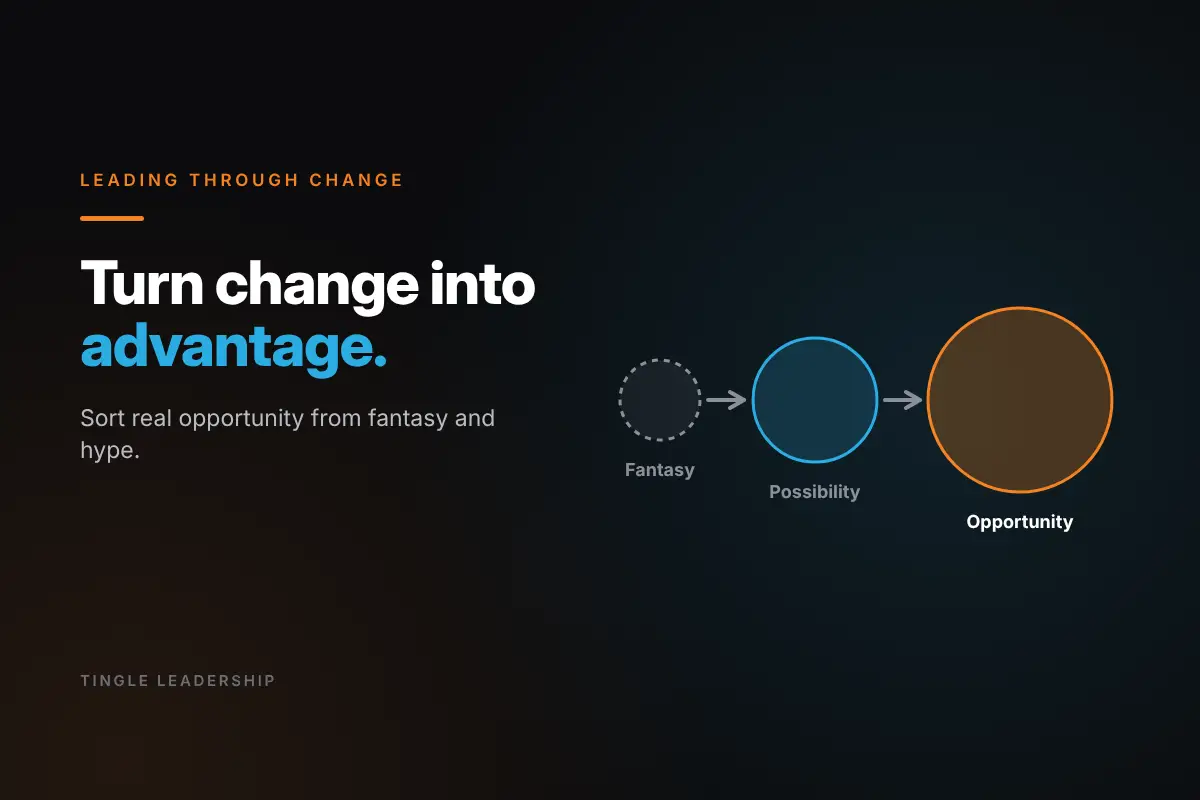
Fantasy, Possibility, or Opportunity?
Not every idea is ready to execute. Here’s a distinction worth carrying:
A fantasy is a desirable future for which no feasible path exists yet. Uber was a fantasy before mobile phones existed. Streaming music was a fantasy before broadband.
A possibility is a desirable future where the path is mostly clear, but something is still missing. One missing resource, one regulation not yet changed, one technology not yet mature.
An opportunity is a desirable future where everything needed is now available. The concern exists. The capability exists. The timing is right.
Great leaders know which of the three they’re looking at. They don’t spend execution energy on fantasies, but they also don’t dismiss them. Fantasies become possibilities. Possibilities become opportunities. The environment shifts constantly, and so does the assessment.
The Uber Lesson
Think about what Uber actually solved.
It didn’t invent transportation. It looked at a set of human concerns (getting from point A to point B reliably, affordably, and on demand) and a set of economic concerns (flexible income for people without traditional employment structures) and asked: what’s now feasible?
The smartphone existed. The GPS network existed. The gig economy mindset was emerging. The regulatory gaps were real. Everything was there. Someone saw the concerns, mapped the feasibility, and built the bridge.
Uber is now both a noun and a verb. That’s what it looks like when innovation lands on real concerns at the right moment.
How to Think About AI Right Now
You’re likely already being asked about AI. You may already be leading AI initiatives. Or you’re watching from the edge trying to figure out where to engage.
Here’s the frame that cuts through the noise:
Start with human and business concerns, not the technology. Ask what concerns exist in your organization that aren’t being well taken care of. Ask what your customers struggle with. Ask where friction, delay, and poor decision-making are costing the business.
Then ask what’s feasible. If AI can address those concerns and the capability exists, that’s not a fantasy or a future-state roadmap. That’s an opportunity sitting in front of you.
The rest is desire and execution.
Leading Through Change: Where Leaders Get This Wrong
They start with the technology and work backward. They ask, “What can AI do?” instead of “What concerns does this take care of?”
That produces demos, not solutions. It produces pilots that never scale. It produces investment without return.
Start with the concern. Follow the feasibility. Then build.
A Note Before You Go
Tingle Leadership turns five this year.
Five years of working with leaders who sensed something was missing and decided to do something about it. Five years of frameworks, conversations, and breakthroughs. I’m proud of what we’ve built, and grateful for everyone who has been part of it.
To mark the anniversary, I’m offering the Human Edge Leadership Foundations Course at 20% off, exclusively for newsletter subscribers.
Use code HELF20 at checkout.
This is the program I wish had existed when I was moving through the ranks.
It’s built on the same frameworks we covered today: human concerns, feasibility, opportunity, and the language and leadership skills that separate good executives from exceptional ones.
If you’ve been sensing that something is missing in your leadership development, you’re probably right. This course was built to address exactly that.
The offer expires soon:
👉 Human Edge Leadership Foundations Course
I hope to see you inside.
P.S. If you’re tired of moving too slowly, so am I. Book a 30-minute strategy call and let’s talk about how to accelerate your journey.