A few years into my time as an IT executive, a CFO pulled me aside after a budget meeting.
He said, “Bill, I trust you know your stuff. But I have no idea what any of it means for the business.”
That landed hard. It changed how I thought about communicating with the C-suite.
I had been thorough, detailed, technically accurate. And completely useless to him.
He didn’t need a systems briefing. He needed to know: does this create risk, reduce cost, or grow revenue? Everything else was noise.
That was the moment I stopped being an IT leader in the room and started becoming a business leader with deep technology expertise.
The difference isn’t subtle. It changes how you’re perceived, trusted, and advanced.
Why Most Tech Leaders Stall at the C-Suite Door
The problem isn’t access. Most senior tech leaders can get a meeting with the CFO, CMO, or COO if they ask.
The problem is what happens in the meeting.
They arrive with updates instead of insights. They speak in terms of systems rather than outcomes. They ask for things before they’ve given anyone a reason to say yes.
The C-suite applies one filter to everyone in the room: does this person think like a business leader or like a functional head?
Functional heads talk about what they did. Business leaders talk about what it means.
That filter decides who gets a second meeting. It also decides who gets sponsored for the next level.
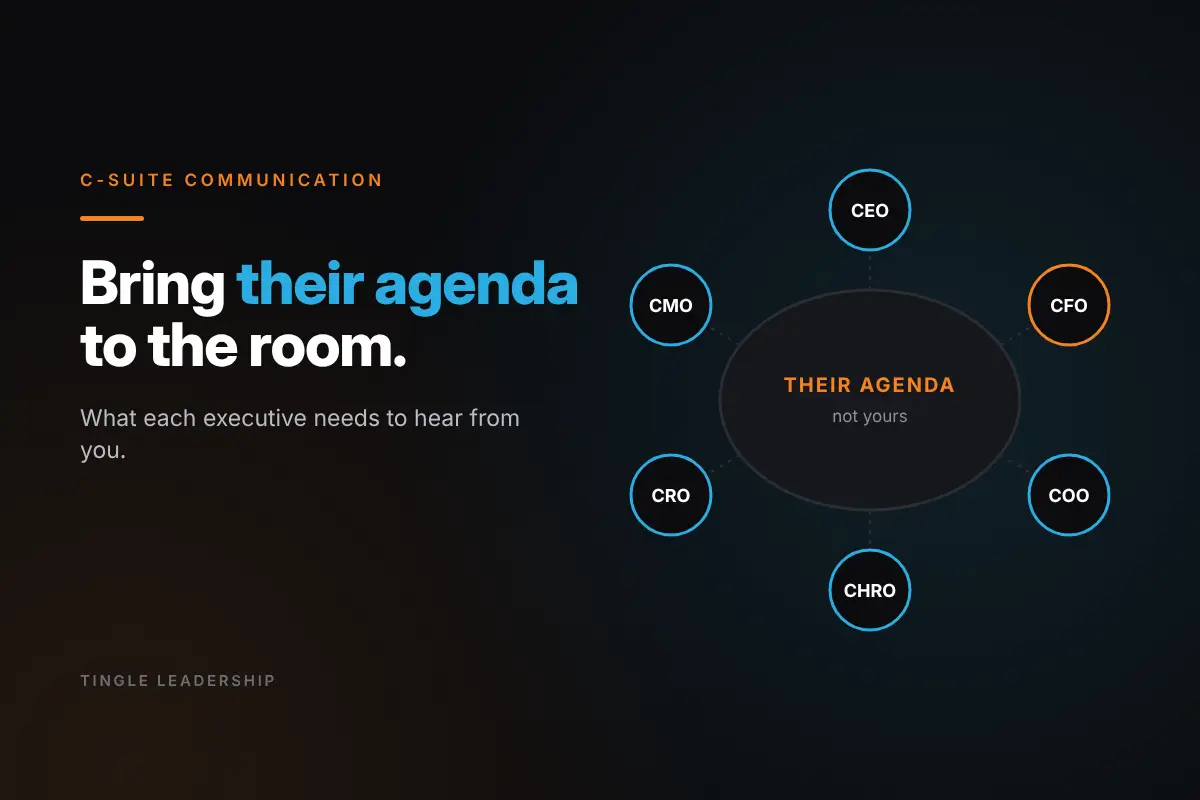
Communicating With the C-Suite: What Each Executive Wants From You
Every C-suite leader has a primary lens. Everything you say gets filtered through it.
CFO: Show me the return. Quantify the risk. Give me a model, not a pitch.
CMO: Connect my customer data to revenue. Show me how technology moves LTV and lowers CAC.
COO: Prove you can scale it. Show me efficiency, cycle time, and headcount impact.
CRO: Help me hit the number and avoid surprises. Revenue intelligence, forecast accuracy, churn signals.
CHRO: Partner with me on the workforce now. AI is reshaping roles. I need you before the crisis, not after.
CEO: What’s the competitive angle? How does this create a moat, open a market, or reduce a real risk?
None of them wants a technology briefing. They want a business conversation where technology is the answer, not the subject.
Before your next executive meeting, ask yourself: Am I showing up with their agenda or mine?
This Week’s Action
Pick one C-suite relationship you want to strengthen. Before you request time, identify one business insight relevant to their function. Not a tech update. A business insight. A market shift, a cost pattern, a risk signal they may not have seen.
That’s your entry point. Lead with their world. Your credibility follows.
I put together a full playbook on this topic: Tech Leaders’ Playbook: Building C-Suite Relationships and Advancing to Executive Leadership.
It covers how to request the initial meeting, how to structure every conversation, what each C-suite role actually cares about, and how to build the sponsorship that drives promotion.
If you want a copy, send an email to bill@tingleleadership.com with the word PLAYBOOK, and I’ll send it to you directly.
If you would like to receive a complimentary 30-minute Executive Execution Strategy session, Book a Discovery Call.
P.S. The leaders who earn C-suite trust don’t wait for a meeting to prove themselves. They build the relationship before the ask. Start that this week. And if you want that playbook, email bill@tingleleadership.com with the word PLAYBOOK, and I’ll send it to you directly.