You didn’t fail the interview.
You didn’t bomb the promotion conversation.
You have the experience. You have the track record. You probably have the credentials.
But someone else got the call. And what stings most is that you can’t always explain why.
Here’s what’s actually happening.
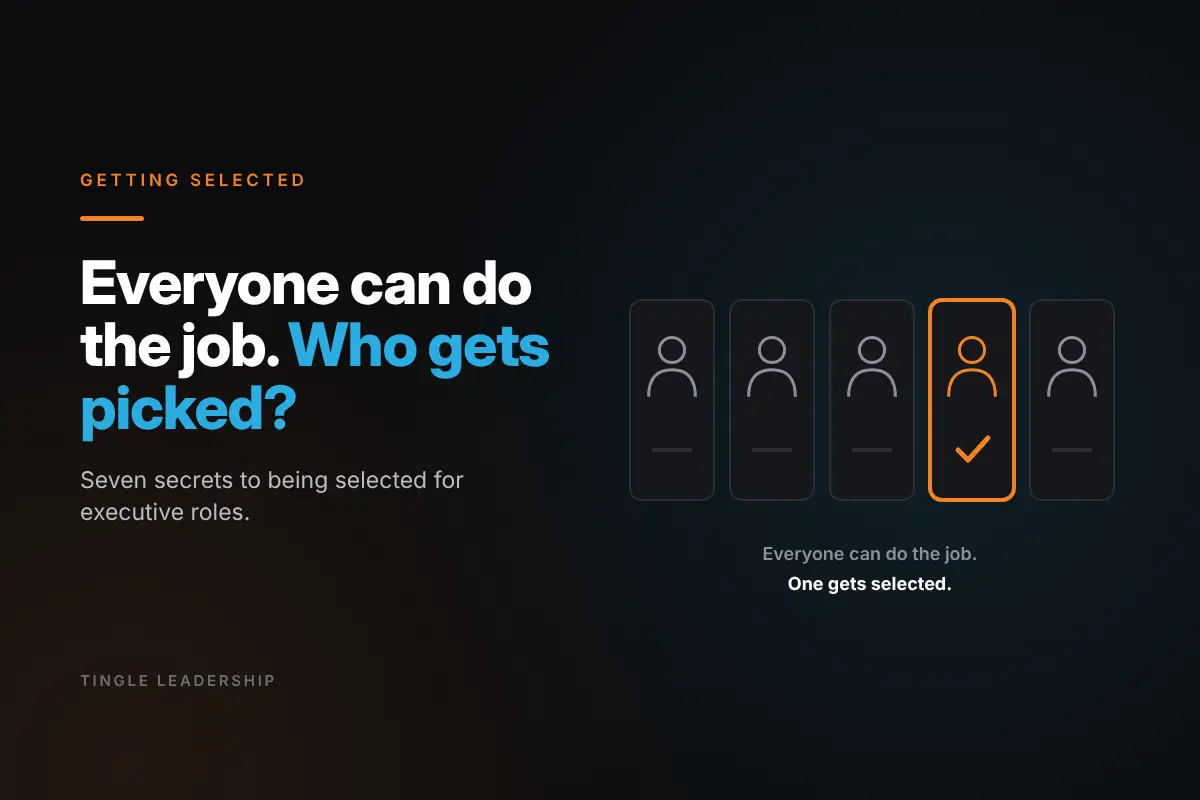
Whether you were passed over for a promotion or ghosted after a final round interview, the dynamic is the same. By the time you’re in that final conversation, everyone being considered can do the job. The question has already shifted.
The real question is: who do we want to work with every day? Who shows up well in the hard moments? Who fits here?
That’s a different game. And most leaders don’t know they’re playing it.
The good news: these are learnable skills. They aren’t mysterious. They aren’t about personality. They’re behaviors. And the leaders who get selected have usually figured them out, intentionally or not.
Here are the seven.
Secret 1: They stay steady when things get uncomfortable.
Decision-makers watch how you handle pressure. Not just what you know, but how you carry yourself when the stakes are high and the answers aren’t clear.
In an interview, that pressure shows up the moment a panel hits you with a hard question or sits in silence after your answer. In a promotion conversation, it shows up when your judgment or your team gets challenged.
Leaders who get selected don’t freeze. They don’t get defensive. They don’t get loud.
They stay calm. They stay constructive. They project the quiet confidence that tells a room: I can handle what’s coming.
This is the signal that gets noticed in every high-stakes interaction. It’s not about being fearless. It’s about not letting the fear run the show.
Secret 2: They make clear decisions and own them.
Indecision reads as weakness at the senior level. Leaders who get selected are willing to choose, even when the path isn’t perfect.
This isn’t recklessness. It’s courage paired with judgment. They make the call, explain the reasoning, and stand behind it without needing constant reassurance.
In an interview, this shows up in how you talk about past decisions. Especially the hard ones. Panels aren’t just listening for what you decided. They’re watching whether you own it. Leaders who hedge every answer, qualify every outcome, and credit every success to the team while distancing themselves from every failure don’t read as humble. They read as uncertain.
Decision-makers want to know: Can I hand this person a hard situation and trust that they’ll move? Leaders who answer that with their behavior get selected. Those who wait for consensus rarely do.
Secret 3: They read the room and adjust.
You can walk into any meeting with the right data and still lose the room. The leaders who get selected know this.
They pay attention to the mood before they speak. They pick up on what people actually need in that moment, not just what they prepared to deliver.
Then they adjust.
In an interview, this means noticing what the panel is actually reacting to.
Sometimes a question isn’t asking for the technical answer. It’s checking whether you understand the real concern behind it. The leader who senses that and responds to the concern, not just the question, stands out immediately.
This is situational intelligence. It’s the skill that turns a presentation into a conversation and a conversation into a decision. It’s the difference between being heard and being remembered.
Secret 4: They communicate with precision and confidence.
Not volume. Not vocabulary. Precision and confidence.
When you speak, people are listening for two things: do you know what you’re talking about, and do you believe it?
Leaders who get selected answer both questions without hesitation. Their language is clear. Their framing is sharp. They get to the point and make it land.
They don’t ramble. They don’t hedge everything. They don’t fill silence with filler. They say what they mean, and they mean it.
In an interview, this is the skill most people underestimate. The candidates who over-prepare tend to over-explain. The ones who get selected know when to stop talking.
Secret 5: They connect before they convince.
The fastest way to lose an audience is to go straight for the ask without building any ground first.
Leaders who get selected understand that decisions are relational. People don’t follow logic. They follow trust. And trust starts with connection.
In an interview, that connection happens in the first two minutes before any real question is asked. The leaders who get selected use the small talk, the walk to the conference room, and the early setup questions to signal: I’m a real person, I’m genuinely interested in you, and I’m easy to be around. That impression is set before the formal conversation starts.
They make people feel seen. They ask good questions. They listen in a way that signals: I care about your concerns, not just my agenda.
Then, when they make the case, it lands. Because the relationship already said: this person is with us.
Secret 6: They look the part without making it a distraction.
This one makes people uncomfortable, but it’s real.
You have roughly five seconds to shape the first impression in any room. Your appearance either reinforces your credibility or pulls attention away from it.
Leaders who get selected don’t show up hoping their work will override a poor first impression. They close that gap before the conversation starts.
This applies on video too. A cluttered background, poor lighting, or a casual appearance in a formal interview tells the panel something before you say a word. It signals either that you didn’t know better or that you didn’t care enough to fix it.
This isn’t about looking perfect. It’s about signaling: I know where I am, I know who I’m talking to, and I took this seriously. That’s a statement of respect. And it registers.
Secret 7: They bring energy that raises the room.
People make selection decisions with their gut and explain them with their head.
What they’re often reacting to is energy. The energy of someone who is confident without being arrogant. Engaged without being performative. Serious about the work without being heavy to be around.
In an interview, the panel is unconsciously asking one question underneath all the others: would I want to work with this person every day? Your energy answers that question before your content does. Leaders who get selected feel like an addition to the room, not an obligation to it.
Leaders who get selected are the kind of people others want in the room. Not because they’re the loudest. Because they make the work feel possible.
That energy is built. It comes from clarity about who you are, preparation that removes anxiety, and the daily practice of showing up with intention.
The quiet truth about the final round interview.
Getting selected isn’t just about what you can do. It’s about how others experience you while you’re doing it.
Whether you’re chasing a promotion or navigating a final round interview, the decision-makers in the room are asking the same questions. Can I trust this person in a high-stakes moment? Will others follow them? Do they belong here?
These seven skills don’t answer those questions with words. They answer them with behavior.
That’s the work. And it starts before the conversation happens.
If you want help figuring out where your gaps are and what to do about them, a Discovery Call is the right starting point. Thirty minutes. Focused on your situation.
Not ready to book? Download The Executive Freedom eBook Summary. It covers the three core shifts leaders make to gain access to bigger roles and more strategic work.
P.S. The next person selected, for the promotion or for the role, won’t necessarily be the most qualified. They’ll be the one the decision-makers feel most confident putting in the seat. That confidence is earned before the conversation happens. Start earning it now.