
You walked out of that meeting knowing your idea was solid.
You had the data. You had the roadmap. You even had a slide deck that took three nights to build. But the CFO checked her phone halfway through. The COO asked a question that had nothing to do with what you just presented. And the CEO gave you a polite nod that felt a lot like a door closing.
Here is what actually happened, and it’s the most common mistake in presenting to executives.
Your idea was not the problem. Your translation was.
Every executive in that room was listening through a completely different filter. If your message did not match that filter, it did not register. Not because they were dismissing you. Because you were transmitting on the wrong frequency.
Today, I am going to show you how to fix that.
The Executive Frequency Map
Think of each executive as a different radio station. You can have the best broadcast in the world. If you are on the wrong channel, nobody hears it.
Here is a quick breakdown of what each executive is actually tuned into.
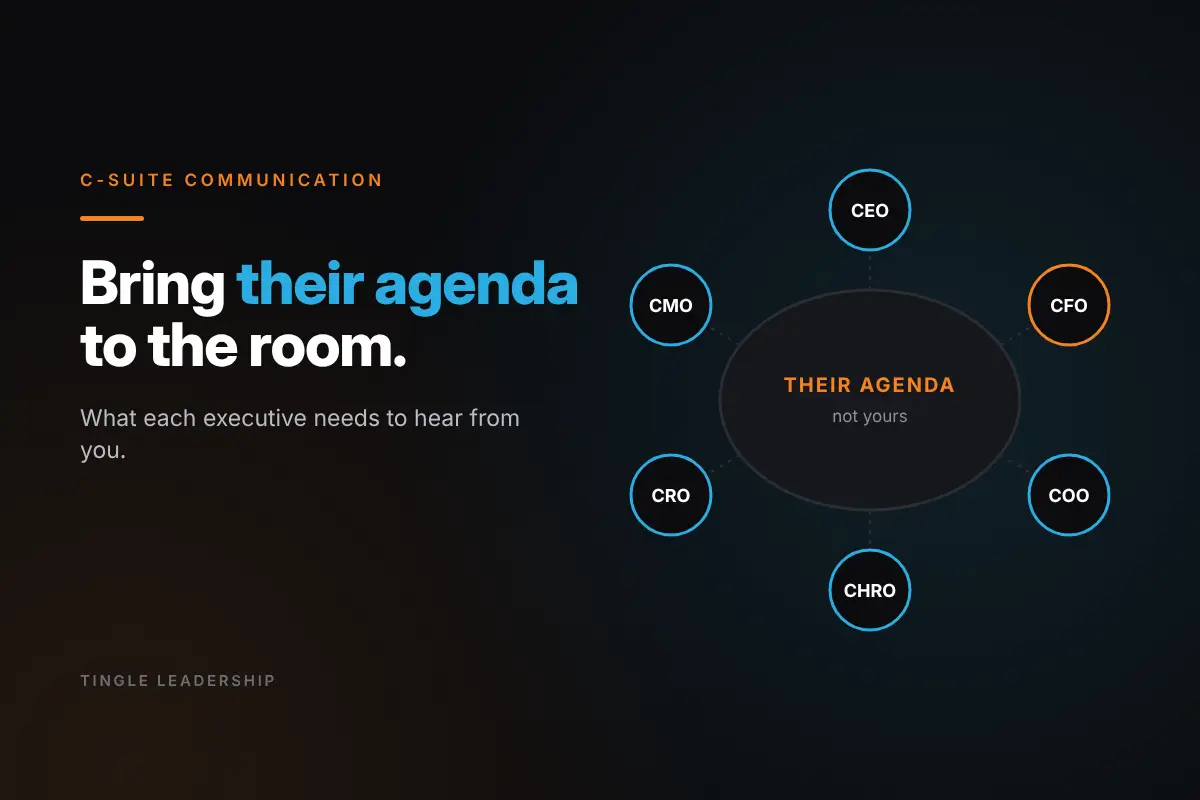
1. The CEO is thinking about the future. Vision, growth, competitive positioning, staying relevant. When you speak to a CEO, your technology story has to connect to where the company is going, not just where it is today. The right question before your next CEO meeting: “How does what I am proposing help us get where you want to be in three years?”
2. The CFO is thinking about money, risk, and sustainability. Every initiative looks like a cost until you frame it as a return. CFOs do not oppose technology. They oppose ambiguity. When you can show what the financial consequences are if the company does nothing, you have their attention.
3. The COO is thinking about execution. Will this create chaos or reduce it? COOs love efficiency and fear complexity. Speak to them in the language of speed, stability, and scale.
4. The CMO is thinking about customers and the brand. If your initiative helps them get to market faster, differentiate, or better understand customers, that is your lead.
5. The CIO or CTO is already on your side technically, but they are managing integration risk and legacy debt. Be honest about what your initiative requires and how it fits with what already exists.
Presenting to Executives: The Three-Beat Translation Formula
Once you know what each executive cares about, the next step is delivering your message in a way that speaks directly to those concerns.
The simplest structure that works every time: Problem. Solution. Business
Benefit.
Here is what it looks like before and after.
Before: “We are migrating our infrastructure to a cloud-native architecture to improve system reliability and reduce technical debt.”
After: “We currently lose an estimated $300,000 per year in customer churn and support costs tied to system downtime. The migration fixes the root cause, improves uptime to 99.9 percent, and frees the team to build new product features instead of fighting fires.”
Same initiative. Completely different impact. The second version is something every executive in the room can connect to their own priorities.
Three techniques to sharpen the translation:
-
- Build a shared vocabulary. Map your technical terms to business outcomes. “Latency” becomes “customer wait time.” “Redundancy” becomes “business continuity.” Small language shifts create big shifts in understanding.
- Tell stories, not status reports. Open with the problem. Walk through the solution. Close with the result. A narrative is far more memorable than a slide full of metrics.
- Quantify in their currency. A CFO tracks margin. A CMO tracks customer acquisition cost. A COO tracks cycle time. When your metrics show up inside their metrics, you shift from presenter to partner.
From Problem Solver to Strategic Partner
The tech leaders who earn the most trust do not just fix things. They bring ideas nobody else saw coming.
The path there is straightforward. Combine what you know about technology with what you have learned about each executive’s concerns. When a CFO mentions margin pressure, ask which technology could automate a cost driver. When a CMO talks about customer retention, ask which data capability could power a better experience.
Start small. Propose a pilot. A contained proof of concept tied directly to one executive’s top priority gives them something tangible to evaluate without requiring a major commitment. When it works, you become the person who opened a door they did not know existed.
That is how tech leaders go from support function to strategic partner.
The five-step formula:
-
- Listen for the pain. Attend strategy meetings. Stay curious. Ask follow-up questions when executives mention challenges.
- Match the pain to a technology capability you already have or can acquire.
- Quantify the potential upside in their language.
- Propose a small, low-risk pilot with a clear success metric.
- Deliver, document the result, and tell the story to the broader leadership team.
Your Action Item This Week
Before your next executive meeting, write one sentence for each leader in the room that answers this question: “What does this person care about most right now, and how does my work connect to that?”
If you can answer that question for every seat at the table, you will walk in with more than a presentation.
You will walk in with a conversation.
If you are ready to accelerate the pace at which senior leaders see you as a strategic partner, let’s talk.
Our Accelerated Executive Coaching Bundle is designed for tech leaders who want to move faster. We work on your executive communication, your stakeholder visibility, and how you show up in the rooms that matter. The result is a leader who is not just heard but asked back.
Book a Discovery Call to explore whether it is the right fit for where you are headed.
Not ready for a call yet? Send me an email at bill@tingleleadership.com and request “The Business Case Playbook” to start building the foundation now.
P.S. The executives in your next meeting are not ignoring you. They are waiting for someone to speak their language. That someone can be you.