You were in the room.
You had the data, the context, the history. Nobody at that table knew the landscape better than you did.
And you still left with half of what you came to say still sitting in your chest.
You drove home replaying it. And somewhere between the parking garage and your front door, you already knew the truth, the uncomfortable one.
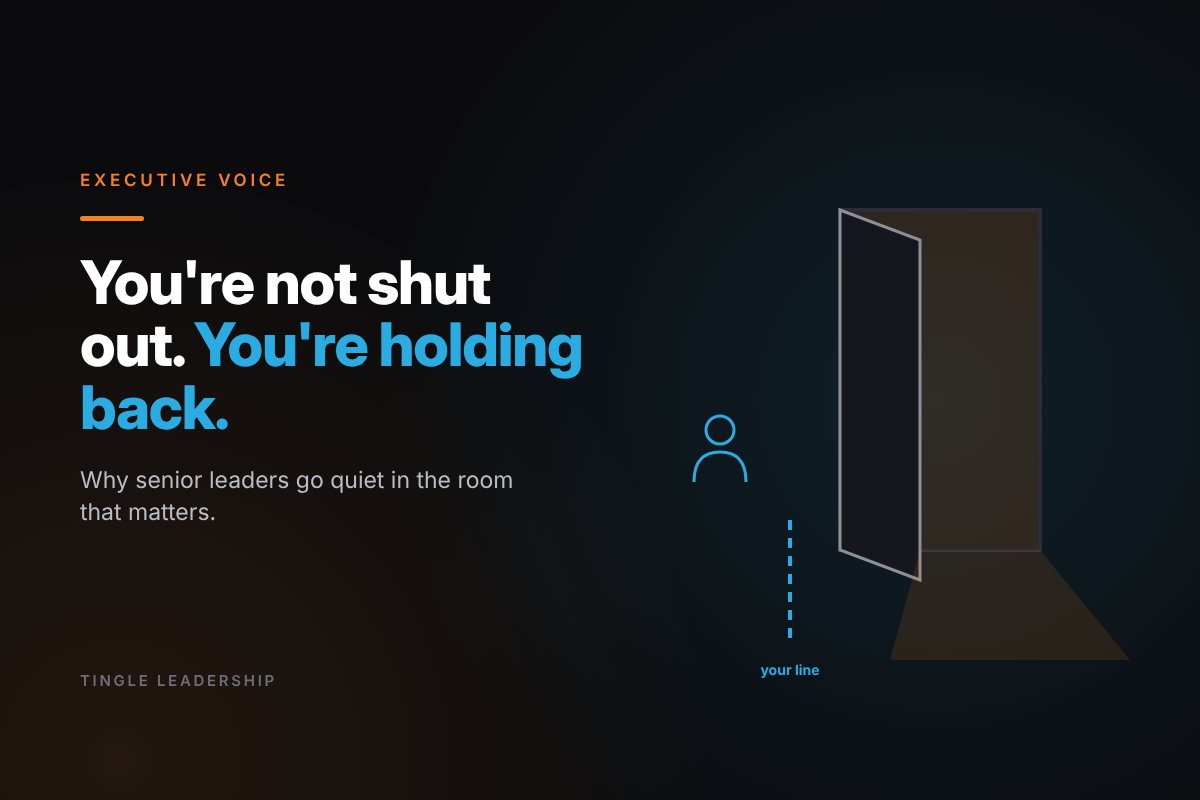
Nobody shut you out. You drew the line yourself. Most barriers to speaking up in meetings work that way.
The story Diane told herself
Twelve years in technology leadership. Hard deliveries. A team that ran well. A reputation for being the person who figured things out.
When Diane finally got a standing seat at the senior leadership table, the first few invitations felt like validation. Then a pattern emerged.
She’d arrive prepared. Present her update. Field questions about systems and timelines. Then watch the conversation shift to the real work, strategy, risk, budget, direction, and go quiet.
Not because she had nothing to say.
A voice in her head kept drawing a line: That’s not your lane. Wait until it comes back to tech.
So she waited. Meeting after meeting. She waited.
One afternoon a peer she trusted stopped her in the hallway.
“Can I be honest? You never say what you actually think about the business. Is there a reason for that?”
Diane stood there for a second.
She didn’t have a real answer.
Because the truth, when she finally sat with it, was this: the title on her badge said Director of Technology. But the identity she was leading from said something smaller.
I’m here for the tech part.
That gap between the role she held and the identity she was inhabiting was costing her more than she realized. And here’s the thing about that gap: it’s invisible until someone names it. Then you can’t unsee it.
The two stories running in the same room
Most senior technical leaders carry a quiet narrative into every executive meeting. It usually sounds something like:
I’m here because they need my expertise. Not because they see me as one of them.
When that story is running, the behavior follows automatically. You wait to be asked instead of volunteering your view. You over-edit mid-sentence, hunting for the right thing to say. You default to detail because that’s where you feel solid. You leave replaying it, wondering if you said too much or not enough.
On the other side of the table, non-technical executives are often running a different story:
We bring them in when we need tech input. But they don’t always think at our level.
So they loop you in late. They skip you on the messy political conversations. They talk about your function more than with you.
The gap between those two stories is where belonging erodes.
What makes this painful is that both sides usually think the other one created the distance. Neither one is right. Both are waiting for the other to go first.
What Trusted Belonging actually is
Trusted Belonging is the third pillar of Executive Freedom. It’s the sense, shared by you and the people around you, that you are not a guest in these rooms. You are one of the people this room is for.
When it’s weak, you feel it in your body before you can name it. You feel like you’re on trial in senior meetings. Every contribution feels like a performance review. You assume that any confusion or disagreement means you did something wrong. You’re rarely part of the off-agenda conversations where real decisions actually get shaped.
When it’s strong, something shifts. You contribute because you see something important, not to prove you deserve the chair. You can disagree without feeling like you just risked your standing. You get pulled into decisions before the formal meeting even happens. Peers and senior leaders text you: What do you think?
You stop trying to earn your seat every single time you sit in it.
The identity you’re leading from
Trusted Belonging starts with a change in how you see yourself. Not how you perform.
Most technical leaders have built their identity around their function. I lead technology. That identity served them well for years. At the senior level, it quietly becomes a ceiling. Not because it’s wrong, but because it’s too small.
When you see yourself only as a functional leader, you represent your domain. You defend your team and your backlog. You speak when the conversation touches technology and go quiet when it doesn’t.
The shift that opens everything up is a single reframe:
From I lead technology to I lead the business, through technology.
That’s not wordplay. It’s a different operating identity. When you hold it, you care about the whole P&L, not just your piece. You ask questions about customers, margins, risk, and culture. You speak up on topics that have nothing to do with servers or code, because you care about the business.
Most people get this backwards. They wait to feel like they belong, then plan to start acting like it. It works the other way. You act like an enterprise leader. Over time, people experience you as one. The feeling follows the behavior. It always does.
The smallest signals carry the most weight
People don’t read your status from your title. They read it from your behavior. And the signals are smaller than most people think.
Visitors sit slightly back. They wait for a direct question before speaking. They over-explain, then hedge. They apologize for taking up space: Sorry, one more thing.
Peers take up normal space. Not loud, not shrinking. They offer a perspective without being asked: From where I sit, I see two implications here. They make their point, then stop. They treat their presence as expected, not extraordinary.
The difference isn’t confidence. It isn’t assertiveness training. It’s this: peers don’t signal surprise at being in the room.
Stop giving that away.
Speaking up in meetings: three moves to start this week
One peer conversation per week. Pick one executive peer outside your reporting line. Schedule 20 to 30 minutes. No agenda item to resolve. Your only goal is to understand their priorities, share one or two of yours, and find where your work connects.
You’re not pitching anything. You’re not defending technology. You’re acting like two enterprise leaders comparing notes.
Do this consistently and their mental model of you shifts. You stop being the tech person. You become a colleague who understands what they’re dealing with.
One enterprise-level contribution per senior meeting. Give yourself a simple rule: in every meeting at director level or above, make at least one contribution that has nothing to do with technology.
Ask how a proposed strategy will land with customers. Name a risk to culture or morale. Connect a current decision to a commitment the company made six months ago.
You’re not abandoning your expertise. You’re expanding the context you bring it into. That’s what changes how people see you, and eventually how you see yourself.
Map your executive ecosystem. Write down your closest peers and the senior leaders above you. Label each one.
Ally: trusts you, involves you early, would speak well of you in a room you’re not in. Neutral: knows you, but not deeply. Could go either way. Skeptic: questions your readiness, your style, or your function’s value.
Now ask: where am I taking allies for granted? Where am I avoiding real conversations with neutrals? Where do I need skeptics to experience me differently, more than once, over time?
Belonging doesn’t grow from one great presentation. It grows from repeated interactions where you show up as clear, steady, curious, and honest.
That’s the whole game.
How Diane’s story ended
A few months after that hallway conversation, Diane stopped waiting for the conversation to come back to tech.
She started asking about customers and margins. She pushed back on a budget decision she thought would hurt morale. She scheduled coffee with the CFO, not to talk about systems, but to understand where the CFO was feeling the most pressure.
Nobody handed her a new title. But the calls started coming before the meetings.
What do you think about this? Can you weigh in before Thursday? I’d like you in the room for this one.
She stopped being a visitor. She became a peer.
That’s what Trusted Belonging makes possible. And it starts earlier than most people think.
Not with a promotion. With a decision about who you’re going to be in the room today.
Ready to build this in 12 weeks?
The Executive Freedom Challenge is a structured 12-week coaching program built around all three pillars: Strategic Autonomy, Visible Authority, and Trusted Belonging.
You work on real situations, with your real stakeholders, in your real organization. Not generic exercises. Not theory without application.
If you’re ready to stop fading into the background in rooms you’ve earned the right to lead, this is where the work starts.
Learn more and apply for the Executive Freedom Challenge
P.S. The promotion you’re waiting for is probably waiting on something much simpler: the version of you that walks into the room like you’ve already arrived.