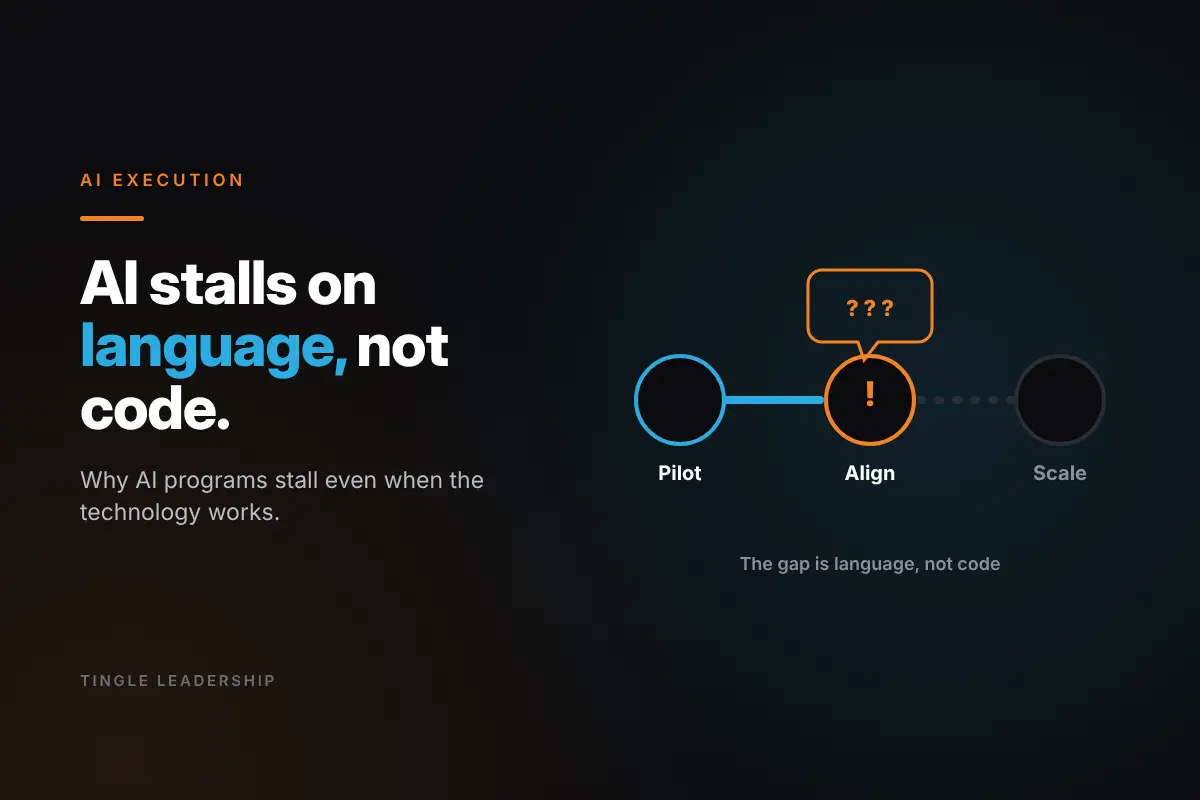
AI is not the reason your organization is struggling.
The primary challenge lies in communication.
Organizations across industries invest millions in AI pilots, yet many struggle to scale these initiatives. This is why AI projects fail. This pattern is consistent.
- Sixty percent of organizations say poor stakeholder alignment and unclear use cases block AI adoption.
- Between 26 and 35 percent report challenges with skills, training, or change management. These are human, not technical problems.
- Global surveys indicate that organizational challenges to AI adoption surpass technical barriers in delivering value.
Ineffective communication causes $1.2 trillion in lost productivity and delays. This issue needs executive attention.
In reality, most AI failures stem from coordination issues rather than technical shortcomings.
Why AI Projects Fail: The Hidden Cost of Implicit Expectations
In many organizations, work is directed by assumptions rather than clear commitments:
- Leaders often presume teams understand the meaning of “AI strategy.”
- Teams may presume that leaders are unified on priorities.
- Departments might presume that others will manage governance, own change management, or oversee training.
Research on workplace miscommunication shows what this costs:
- Large companies lose tens of millions of dollars annually to unclear directives and misunderstood roles.
- Employees spend weeks each year clarifying expectations instead of working.
In AI programs, this manifests as:
- Multiple teams may prototype similar use cases in parallel without awareness of each other’s efforts.
- Some pilots work technically, but lack clear ownership for integration into core workflows.
- Governance was discussed, but never concretely defined as who decides what, by when, and using which criteria.
The Missing Link: Human Leadership Language Models
AI Large Language Models (LLMs), machine learning systems trained on massive amounts of data, are built to process and generate language. They are extraordinary at information synthesis, content generation, conversational interaction, workflow automation, and much more.
What they cannot do is:
- Establish trust between humans.
- Create binding commitments inside your org chart.
- Decide whose judgment wins when there’s a trade-off between speed and risk.
These are human coordination challenges that can be addressed through a Human Leadership Language Model (Human LLM), which is a disciplined approach for leaders to use language intentionally to create clarity, alignment, and action within teams and organizations.
The key is not magic; it is using language intentionally.
- Declarations – “This is our AI priority and here’s what it means.”
- Assessments – “Here’s my evidence-based view of our readiness and risks.”
- Requests – “I am asking you to own X outcome by Y date, defined as Z.”
- Commitments – “Yes, I will deliver that, under these conditions and standards.”
- Offers – “Here’s the support I can provide so you can keep that promise.”
Most AI steering groups focus on statements like “AI is a priority.” They rarely make requests or commitments, such as “Who will own this by Friday?”
Leaders can address this gap immediately through decisive action.
Three Moves You Can Make This Week
Consider these three specific actions to significantly improve AI coordination:
1. Declare Your AI Intent in One Clear Paragraph
Currently, stakeholders in your organization may have differing perspectives on the purpose of AI. Some see it as a tool for cost reduction, others for innovation, and some as a potential job threat.
Your first step as a leader is to make a clear, grounded declaration that answers: Why are we implementing AI? What are we prioritizing first? What will remain unchanged for now?
Document your declaration, review it with your leadership team, test for alignment, and communicate it broadly.
Research on AI adoption shows that a lack of shared understanding of goals and boundaries is a primary barrier to scaling. A clear declaration is the most effective alignment tool available.
Prompt yourself:
“If someone on the front line asked, ‘Why are we using AI, and what does it mean for me?’ could every leader in my organization answer in one consistent paragraph?”
If your leadership team cannot do this today, addressing it should be your highest priority.
2. Turn One Critical AI Meeting into a “Conversation for Action.”
Select a high-stakes AI meeting, such as a steering committee, use-case prioritization, or governance discussion. Clarify the meeting’s purpose in advance:
“By the end of this meeting, there will be specific, named commitments establishing who is responsible for each action, by when, and how success will be measured.”
Then, structure the meeting in six steps:
1. Context (5 minutes)
Restate the declaration: why you’re here and what future you’re trying to create.
2. Assessments (10 minutes)
Each key stakeholder gives a short, evidence-based assessment: “Here’s what I see that’s working / not working in our AI program.”
3. Requests (10 minutes)
You or the chair make explicit requests:
- “I request that [Name] lead the design of our AI governance framework.”
- “I request that [Function] identify three high-value use cases by [date].”
4. Negotiation (10 minutes)\
Allow participants to accept, decline, or propose alternatives. Identify any constraints, such as “I can, if…” or “I can’t, but I can do…”. Addressing these issues now prevents future misunderstandings.
5. Commitment Round (10 minutes)
Go around the room. Each person states:
“I commit to [outcome] by [date]. Done means [X]. I’ll need [Y] from [Z] to succeed.”
Document these commitments in writing.
6. Offers & Next Check-in (5 minutes)
Ask, “What support do you need?” Offer assistance, such as removing blockers, securing stakeholders, or clarifying dependencies. Then, set the next review date.
Organizations that adopt this approach see significant improvements in commitment reliability and schedule stability. The result is fewer instances of “we’ll see” and more of “I will.”
3. Replace One Vague AI “Update” with a Concrete Commitment
Review your upcoming AI-related meetings and identify moments where vague language is typically used, such as:
- “Let’s try to have that ready soon.”
- “We should really tighten up our AI governance.”
- “You own AI change management, right?”
In those moments, shift from expressing expectations to making explicit commitments:
1. Make a specific request
“Can you own drafting a one-page AI governance proposal, covering decision rights, risk thresholds, and escalation paths, by next Wednesday at 4pm?”
2. Invite a real response
“Is that doable? What would you need to make that date realistic?”
3. Capture the commitment
“Great. So you’re committing to deliver [X] by [Y], and done looks like [Z]. Let’s review it together in next week’s check-in.”
While this may seem minor, applying it consistently across interactions can be transformative. Instead of vague intentions, you create a visible network of commitments that can be managed and improved.
Research on commitment-based management shows that making commitments visible can increase on-time promise-keeping from 30 to 40 percent to 60 to 70 percent within a few months. This reliability is essential for AI programs to progress from pilot to production.
A Closing Thought
AI will fundamentally transform your organization’s operations. However, organizations that achieve a competitive advantage may not have the most advanced models.
They’ll be the ones where leaders know how to:
- Declare a clear AI intent,
- Create a shared understanding of reality, and
- Turn critical conversations into explicit commitments.
AI will help you process, analyze, and generate information at scale, so humans can focus on judgment, alignment, and decision-making.
If you choose to implement any of these three actions this week, I would appreciate hearing about your results.
P.S. If you are experiencing challenges in delivering and scaling your AI initiatives, or any initiatives for that matter, there are likely human language challenges. Book a call to discuss and explore solutions.