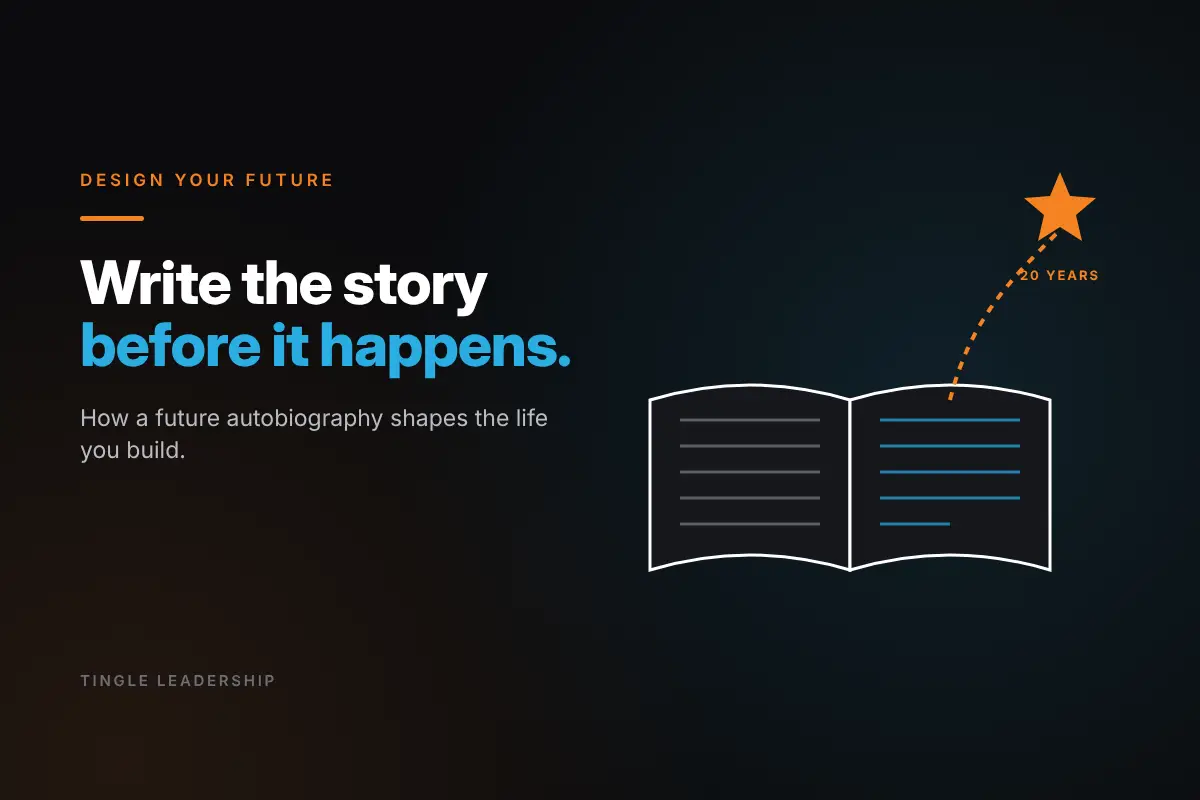
Twenty years ago, I sat down and did something that changed my life forever. I wrote my autobiography. But here is the thing. I wrote it before it happened. That’s what I call a future autobiography.
I imagined myself twenty years into the future. I wrote vivid stories about my family life, my faith journey, my career success, my financial situation, and my personal growth. I did not list goals. I wrote complete stories filled with rich details and deep emotions. I described what I saw, what I felt, and who I had become.
Today, two decades later, I can look back and see something remarkable. My life turned out very much as I wrote it. In many ways, it turned out even better.
This is not magic. This is not wishful thinking. This is science. In my coaching program today, I guide leaders through this same powerful exercise of writing their future autobiography. The results speak for themselves.
Let me share with you why this works and how you can use it to design the future you deeply desire.
What Is a Future Autobiography?
A future autobiography is a written story of your future life, told as if you are already living it. Instead of writing, “I want to be healthier,” you write, “It is a beautiful Saturday morning. I wake up feeling energized and strong. I lace up my running shoes and head outside, feeling grateful for my body’s strength as I run through the park.”
See the difference? One is a wish. The other is a vivid experience.
In my coaching program, participants choose their own timeframe, usually five or ten years out. Then they write their future story across multiple life domains.
- Family. What do your relationships look like? How do you spend time together?
- Faith. How has your spiritual life grown? What practices sustain you?
- Work. What are you accomplishing? What impact are you making?
- Money. What is your financial situation? How does that feel?
- Health. How do you feel in your body? What do you do to stay well?
- Education. What have you learned? What skills have you mastered?
- Entertainment. How do you enjoy life? What brings you joy?
The key is to write with vivid imagery and intense emotion. You do not just say what you will do. You describe what you see, hear, smell, and touch. Most importantly, you describe what you feel.
Why Emotions Matter So Much
Here is something most people do not understand. Your brain treats vivid mental images almost the same as real experiences. There is a catch. Without emotion, the images do not stick.
Research shows mental imagery acts as an emotional amplifier in your brain. When you imagine something without emotion, it is like watching a boring movie. Your brain does not pay much attention. When you add strong feelings such as excitement, pride, joy, or gratitude, your brain lights up.
When you write your future autobiography with vivid emotion, you are not daydreaming. You are creating a powerful brain experience that feels real.
The Brain Science Behind Your Future Story
Let’s look at what happens in your brain when you write your future autobiography with vivid details and emotions.
Your Brain Cannot Tell the Difference
Brain imaging studies show something remarkable. When you vividly imagine doing something, your brain activates almost the same areas as when you actually do it.
Scientists studied basketball players practicing free throws in three ways. One group practiced physically. Another group imagined practicing through mental rehearsal. The control group did nothing. The physical practice group improved their free throw percentage. The mental practice group improved almost as much, without ever touching a basketball.
Similar studies with piano players showed the same effect. People who only imagined playing piano showed real changes in the brain regions that control finger movements. Their brains changed through imagination alone.
This is called neuroplasticity. It is your brain’s ability to rewire itself based on experience, both real and imagined.
Building New Neural Highways
Think of your brain like a forest. The more you walk the same path, the clearer the trail becomes. Each time you vividly imagine your future self, you strengthen that neural path.
Research shows visualization strengthens neural pathways related to your goals. It creates a clear route that makes it easier to move toward what you want.
When surgeons practiced a difficult procedure using mental rehearsal alone, brain scans showed real changes. Their motor cortex became more efficient. Their prefrontal cortex became less stressed. Mental practice produced physical brain changes that improved real world performance.
The Reticular Activating System: Your Brain’s Search Engine
Deep in your brain sits a small but powerful structure called the Reticular Activating
System, or RAS. Think of it as your brain’s filter and search engine.
Every second, your brain receives millions of bits of information. You cannot process all of it. Your RAS decides what gets attention.
When you write detailed stories about your future, you train your RAS to search for anything related to those goals. You begin noticing opportunities, resources, and connections that were always present but previously unseen.
Have you ever decided to buy a certain car and then noticed it everywhere? The cars did not increase. Your attention did.
Writing your future autobiography tells your RAS, “This matters.”
The Self-Fulfilling Prophecy
Psychologists have studied the self-fulfilling prophecy for decades. What you expect influences how you behave, which helps create the outcome you expect.
In a well-known study, teachers were told certain students were late bloomers. The students were chosen randomly. By the end of the year, those students showed greater improvement. Teacher expectations shaped behavior, effort, and encouragement.
When you write your future autobiography with emotion and conviction, you create expectations that shape your choices and persistence. You begin to become the person in the story.
Why Writing It Down Is Essential
You might ask if imagining the future is enough. Research shows writing matters.
People who write down goals are significantly more likely to achieve them than those who only think about them.
A study by Dr. Gail Matthews found people who wrote goals were 42 percent more likely to achieve them. Another study showed a 33 percent improvement compared to unwritten goals.
Writing creates clarity. Writing engages more of the brain. Writing creates commitment. Writing helps process emotion. These effects combine to drive action.
How to Write Your Future Autobiography
Step 1. Choose Your Timeframe
Pick a future point that allows growth while staying imaginable.
Step 2. Select Your Life Domains
Choose areas that matter most to you.
Step 3. Write as if You Are Already There
Use present tense. Write from the future.
Step 4. Use Vivid Sensory Details
Engage sight, sound, touch, smell, and taste.
Step 5. Focus on Emotions
Describe how you feel. Emotion drives memory and motivation.
Step 6. Make It Believable
Stretch yourself while keeping it realistic.
Step 7. Read It Regularly
Repetition strengthens neural pathways and attention.
My Story: Twenty Years Later
I wrote about meaningful work, deep relationships, financial stability, and growth. I wrote about coaching leaders and making an impact.
Not everything happened exactly as written. Many things turned out better.
The writing shaped what I noticed. It shaped how I responded to opportunity and challenge.
That is the power of writing your future autobiography.
The Science Says It Works
Mental imagery activates real brain regions.
Emotion amplifies motivation.
Writing goals increases achievement.
Visualization trains attention.
Clear goals outperform vague ones.
Connection to your future self improves decisions today.
Your Turn: Write Your Future
You shape your future through the stories you repeat.
Write yours with clarity.
Write with emotion.
Write as if it is already happening.
Your brain will respond.
Years from now, you may look back and see how your words became your life.
Start writing today.
I mentioned how we do this exercise in our group coaching program. If you’d like to learn more, visit Human Edge Velocity.
If you would like to have a conversation with me, Book a Call