“I know this idea is right for the business. I just can’t get anyone to move on it.”
Chances are, you’ve found yourself in this situation.
You recognize the opportunity. You’ve mapped out the AI use case, considered the competitive landscape, and weighed the potential upside. The path forward seems clear.
Yet, somewhere between your initial insight and the boardroom, momentum fades. The CEO asks for more evidence. The CFO requests a robust AI business case. The board seeks reassurance that peers are moving in the same direction. Your project is relegated to a growing list of possibilities, and the window of opportunity quietly closes.
Progress stalls, and the organization remains unchanged.
The uncomfortable truth is this: the strength of your idea was never the issue. The real challenge lies in the process, or lack thereof, that moves ideas from conception to committed action.
Many senior technology leaders excel at generating innovative ideas, but struggle to shepherd those ideas through the complex machinery of the organization. Critical steps are often overlooked. Leaders enter the boardroom prematurely, presenting technical capabilities when what’s truly needed is a compelling business strategy.
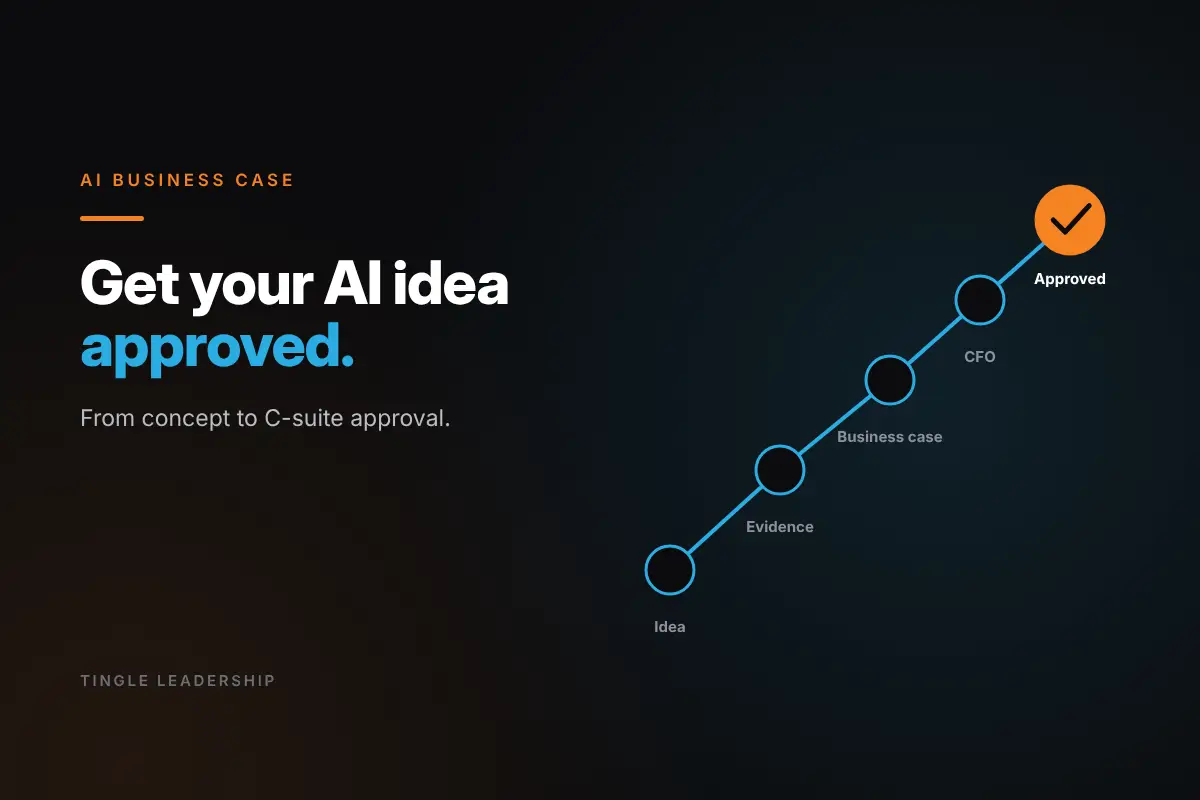
To address this, I coach senior technology leaders to adopt a disciplined, four-part cycle, one that transforms AI-enabled business models from promising concepts into fully committed enterprise initiatives.
The 4-Part Cycle: From AI Idea to Enterprise Strategy
1. Invent with discipline, not excitement
A common misstep at this stage is to begin with the allure of AI capabilities, rather than anchoring the effort in a clearly defined business problem.
The operator asks: “What can we do with this technology?”
The enterprise leader asks: “Where is the market moving, and how can AI change the way we create and capture value?”
Begin by mapping your current business model: customer segments, value propositions, revenue streams, and cost structure. Use competitive intelligence to surface emerging pressure points and new opportunities. In this approach, AI serves as a lever for transformation, not the initial focus.
Consider several patterns that frequently yield results:
- augmenting your existing model with AI-based personalization or dynamic pricing
- shifting from product to outcome-based services
- orchestrating platform ecosystems that create network effects.
Reflect: Are you designing your AI strategy in the context of a robust business model, or are you simply pitching a solution in search of a problem?
2. Validate before you socialize
This is the stage where most ideas quietly fade, not in the boardroom, but in the corridors of informal conversation. Leaders often bypass validation, rushing straight to the pitch. The result is a promising idea unsupported by evidence, and no executive will risk organizational resources on conviction alone.
Validation has three parts.
First, rapidly assess technical feasibility. This does not require a full-scale build. Instead, develop a proof of concept that verifies your data quality, AI methodology, and the complexity of integration are all within manageable bounds.
Second, leverage AI tools to conduct market analysis, test your messaging, and model the underlying economics, well before committing significant resources.
Third, launch a focused pilot. Clearly define success criteria at a limited scale, gather tangible results and customer feedback, and systematically document your learnings.
I worked with a CTO who had a strong concept for AI-enabled services. Smart idea. Compelling market logic. He went to the board without validating the unit economics. The board pushed back hard. The project stalled for six months while he rebuilt the case from scratch.
The evidence gathered during validation forms the backbone of your narrative in the boardroom. Without it, you are effectively asking for trust that has not yet been earned.
Ask yourself: Before I pitch this, do I have a proof of concept, a pilot result, or a validated market signal? Or am I asking the board to bet on my conviction?
3. Socialize before you present
The boardroom should not be the arena for your idea’s first rigorous test. By the time you enter that meeting, key executives ought to be familiar with the core vision, have already posed their toughest questions in private, and be positioned to support the direction.
Engage early with the CEO, CFO, CHRO, and relevant P&L leaders. Share your perspective, invite their concerns, and refine your approach based on their input. Ensure each leader understands their role in operationalizing the model. When functional leaders feel included in the process, they become advocates in the boardroom rather than skeptics.
When it is time to present, lead with a compelling narrative rather than overwhelming the audience with technical minutiae.
Context: why the market calls for a response now.
Vision: the future state in business terms.
Model: how the AI-enabled approach works, who it serves, and how it creates enterprise value.
Path: what you’ve learned, what the next 12 to 24 months look like, and what decisions you need.
Frame your message in terms of outcomes: revenue growth, margin improvement, organizational resilience, risk mitigation, and enhanced customer experience. The board is not seeking architectural diagrams; they require assurance that the initiative is aligned, de-risked, and governed effectively.
Ask yourself: When I walk into that boardroom, will the key executives be hearing this for the first time? Or will they already be prepared to move?
4. Build a strategy that the organization can actually execute
This is the juncture where many initiatives lose momentum. The board grants its endorsement, enthusiasm is high, yet execution falters because ownership is unclear.
A real execution strategy requires four things.
First, establish explicit alignment between the AI initiative and the company’s strategic objectives. This alignment should be documented, not merely assumed.
Second, define a concise, prioritized set of use cases that are essential to realizing the model. Focus on the three that truly matter, rather than diluting effort across numerous pilots.
Third, articulate a clear operating model: specify ownership for data governance, cross-departmental coordination, and AI risk and compliance.
Fourth, develop a comprehensive change plan that addresses the human dimension: skills development, communication strategies, adoption pathways, and the inevitable cultural resistance that will arise.
Leaders who excel in this domain do not view strategy as a static document. Instead, they manage it as a dynamic portfolio, retiring what fails to deliver, doubling down on what works, and providing the board with regular, outcome-focused learning reports rather than mere status updates.
Ask yourself: After the board approves this, who owns execution? Is the operating model defined? Do I have a change plan, or am I assuming adoption will happen on its own?
The bottom line on your AI business case
Senior technology leaders who deliver genuine AI-enabled transformation do more than generate strong ideas. They construct and sustain the cycle that converts ideas into strategy, strategy into evidence, evidence into organizational alignment, and alignment into effective execution.
This cycle can be learned and repeated. It is the distinguishing factor between leaders who actively shape the enterprise agenda and those who remain on the sidelines, waiting for an invitation.
If you want to build that capability, lets talk.
The Executive Freedom Program is a 12-week coaching engagement for senior tech leaders who are ready to move from delivering results to setting the agenda. We work on Strategic Autonomy, Visible Authority, and Trusted Belonging, the three capabilities that determine your influence at the C-suite and board level.
Book a call to learn more about the Executive Freedom Program.
Not ready for a call yet?
Request the Executive Freedom eBook Summary that walks you through the foundation.
P.S. The strength of your ideas is not the issue. Most senior technology leaders possess compelling concepts. The real gap lies in the disciplined cycle that moves an idea from initial insight to board-level commitment. Build that cycle, and you will see your ideas gain traction.