“I delivered everything they asked for. I have no idea why I didn’t get the promotion.”
Have you said something like this? Maybe not out loud. But you’ve thought it.
You delivered the project. On time. Under budget. Zero major incidents. By every technical measure, you crushed it.
But someone else got the CTO seat, and you’re left wondering how to become a CTO when delivery isn’t enough.
You tell yourself it’s politics. Or timing. Or that the decision was already made before the interviews started.
And maybe there’s some truth to that. But there’s also something else. Something nobody told you to fix.
I watched it happen live.
A Director presented a $2M project to the board. Flawless delivery. Brilliant technical mind. Then the CEO asked about strategic impact.
He froze. Talked about uptime metrics for two minutes. The room went quiet.
Three months later, the promotion went to someone else.
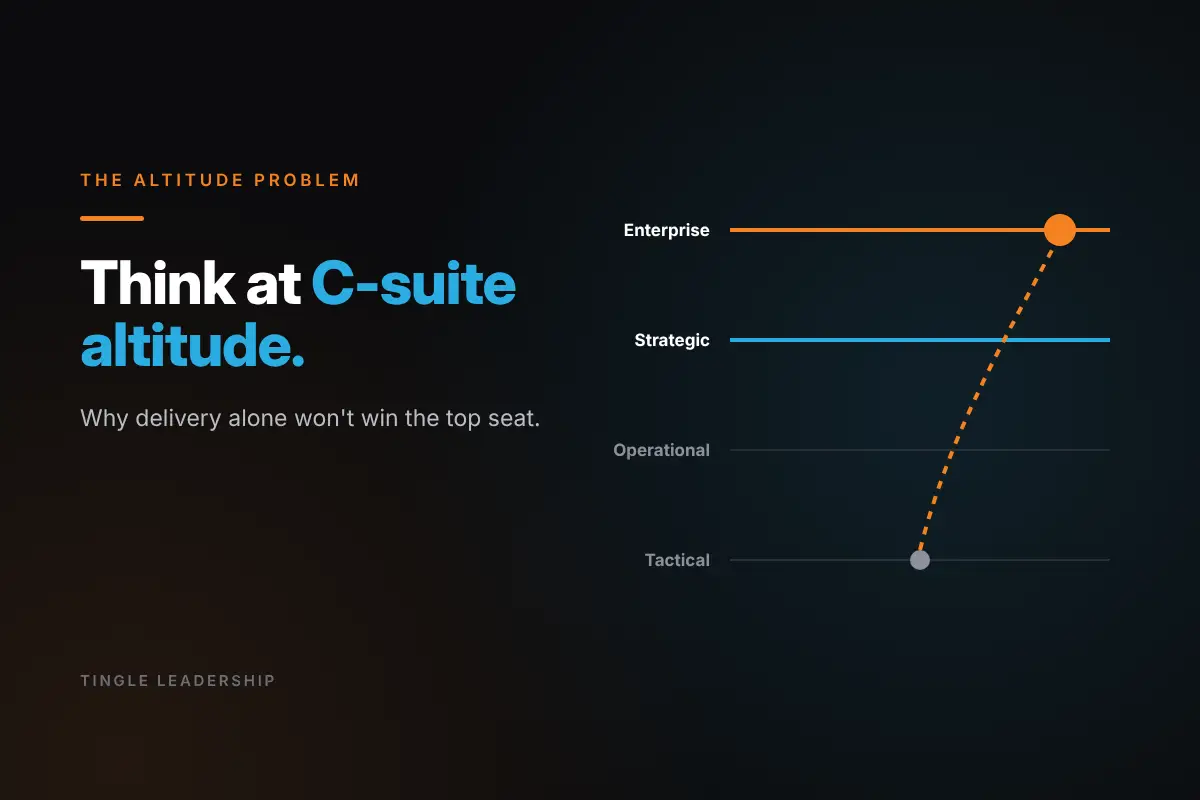
His problem wasn’t competence. It was altitude. He was speaking at the wrong level for the room he was in.
Today I’m sharing the 3 shifts that get IT Directors chosen for the C-suite. Continue reading, I have a free resource for you.
How to Become a CTO: 3 Altitude Shifts
1/ Translate technical work into business outcomes
Most IT Directors report what they did. Senior leaders want to know what it was worth.
Those are two different conversations.
The metrics you track, uptime, ticket resolution time, system performance, are internal scorecards. They mean nothing to a CFO or CEO unless you connect them to money, speed, risk, or competitive advantage.
Here’s what the translation looks like:
Instead of: “We achieved 99.9% uptime this quarter” Say: “Our infrastructure stability let Sales close $3.2M in deals without a single system interruption”
Instead of: “We reduced incident response time by 40%” Say: “Faster resolution saved 120 hours of productive time, equivalent to $48K in recovered capacity”
Instead of: “We migrated to cloud” Say: “The cloud migration cut IT overhead by 30%, freeing $200K annually for initiatives the CEO prioritized”
Run this test: Pull your top 3 accomplishments from last quarter. Rewrite each one to answer: What business problem did this solve? What revenue did it protect or enable? What strategic goal did it advance?
Bring that language to your next executive meeting. Watch how the room responds differently.
2/ Speak in commitments, not status updates
Status updates keep you in the operator seat. Commitments move you into the leader seat.
One of my clients, I’ll call her Julia, had been a Director for seven years.
Consistently delivered. Never got the CTO seat. When I asked her to walk me through how she talked in executive meetings, the pattern was clear.
Every update was passive. “We’re working on it.” “Things are progressing.” “We should have that wrapped up soon.”
No ownership. No timeline. No accountability signal.
We made one shift. She started speaking in structured commitments.
Instead of: “We’re working on the security audit,” She said: “I commit to delivering the security framework by March 15th. That reduces our compliance risk by 60%.”
When the CFO said “we need better reporting,” Julia stopped nodding and started clarifying.
“I can deliver automated financial dashboards by the end of Q2. Does that meet your timeline, or do you need it sooner?”
Clear request. Clear promise. Clear accountability.
That one shift changed how the C-suite assessed her. From reliable executor to trustworthy strategic partner.
3/ Install a governance rhythm that removes surprise
Most execution problems aren’t technical. They’re coordination failures.
Missed deadlines, misaligned priorities, last-minute escalations. These are the signals that keep leaders stuck at the Director level. Not because they can’t execute, but because the people above them can’t predict them.
Julia installed a weekly cross-functional governance rhythm with her key stakeholders. Every week: shared priorities, visible blockers, clear commitments.
No more surprise delays. No more competing agendas discovered in the wrong meeting.
Delivery cycles improved 35%. More importantly, the CEO started describing her differently.
“You’ve become someone I can trust to think strategically, not just execute tactically.”
That’s the phrase that unlocks the next level.
Reflection prompt: Who in your organization is surprised by your updates when they shouldn’t be? That’s your coordination gap. That’s where your Visible Authority is leaking.
Six months after we worked through these three shifts together, Julia was promoted
to CTO with a $55K raise.
The technical ability was always there. The altitude shift is what got her chosen.
If you’re a Director who’s tired of being overlooked despite delivering results, let’s have a conversation.
I help technical leaders build the executive presence, commitment language, and execution credibility that gets them chosen at the next level.
Book a 30-minute discovery call here
I’ve coached hundreds of leaders through this. The ones who move are the ones who decide to act.
Not ready to book a call yet? Start here. The Executive Freedom eBook Summary breaks down the three pillars that separate leaders who get chosen from those who keep waiting: Strategic Autonomy, Visible Authority, and Trusted Belonging. It’s a fast read with a clear framework you can apply this week.
P.S. The Executive Freedom Challenge is not a confidence program. It’s a 12-week structured shift in how you show up, speak, and get seen at the executive level. Strategic Autonomy. Visible Authority. Trusted Belonging. If you want a concrete plan, not just motivation, book a call and let’s look at where you are.
If you’re ready to talk, book a call.