If you are a tech leader responsible for leading AI initiatives, this newsletter edition is for you. If not, read on; we’ve got insights here for all leaders.
Over the last year, AI has moved from lab to boardroom, and explaining AI to the board is now part of the job. CEOs and Board Members now want clear answers: What can AI really do? Where will it create value? How risky is it? And what happens if it goes wrong?
Many technology executives feel caught in the middle. They’re expected to deliver transformative outcomes on aggressive timelines, often with fuzzy expectations and little shared understanding of how AI actually works. When results fall short, or an incident hits, IT becomes the easy target.
There’s a better way.
The CIO’s job is no longer to “sell AI.” It’s to design a shared understanding and a shared operating model for AI across the leadership team, so outcomes and risks are co-owned rather than thrown over the wall.
Below is a practical approach technology executives can use with their peers, boss, and board.
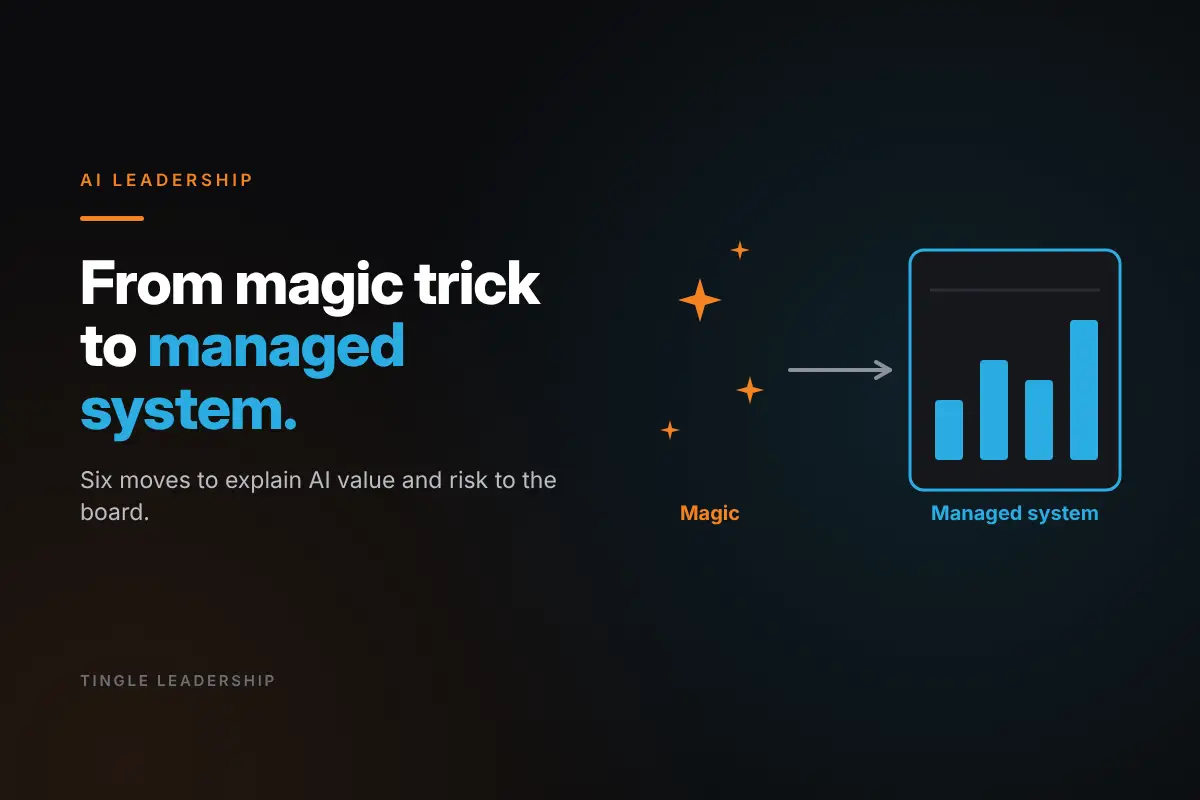
1. Reframe AI: From Magic to Managed System
Step one is changing the mental model.
Instead of treating AI as a showcase of futuristic capabilities, position it as a system of intelligence that influences how your company sees, decides, and acts. Anything that shapes decisions and operations at that scale deserves the same governance attention as finance, security, or safety.
Helpful language:
- “AI is now part of our decision-making infrastructure. We have to understand how it behaves, how we control it, and how we hold it accountable.”
- “If AI affects revenue, cost, risk, or brand, it belongs in our core governance conversations, not off to the side in an innovation lab.”
This reframing pulls AI out of the “tech toy” category and into the domain where boards and executives already know how to think: strategy, governance, and risk.
2. Teach Deterministic vs Probabilistic in Plain English
Most of the confusion around AI expectations comes from a simple misunderstanding: leaders assume all systems behave like traditional software.
Two concepts unlock the conversation:
- Deterministic systems: Same input, same output, every time. Great for compliance, repeatable logic, and tightly controlled processes.
- Probabilistic systems: They work in likelihoods and patterns. They give you “best guesses” with confidence, not guarantees.
Then connect this to decisions:
- “For high-risk, high-impact decisions, probabilistic AI will recommend; humans will decide.”
- “For well-understood rules, we’ll use deterministic logic to fully automate with auditability.”
Once executives see this distinction, it becomes much easier to talk about where AI can be fully automated, where it should be advisory, and where it doesn’t belong at all.
3. Create a Shared AI “Design Contract”
To avoid becoming the sole owner of success or failure, formalize an AI design contract for each important use case. This is a one-page agreement, not a 60-slide deck.
Key elements:
- Decision owner: Which business leader owns the decision where AI is used (for example, underwriting, pricing, credit, fraud, marketing).
- Role of AI: Is it recommending, ranking, detecting anomalies, or executing actions?
- Risk thresholds: Where automation is allowed, where human-in-the-loop is required, and where AI is advisory only.
- Failure modes: What happens when AI is wrong or drifts? Who can pause, override, or roll back?
Reviewing this contract with the CFO, COO, CHRO, legal, and risk converts AI from “the CIO’s project” into a shared management commitment.
4. Tell AI Stories with Numbers, Not Just Dashboards
Boards don’t need a tour of your architecture. They need a clear story of how AI behaves, where it creates value, and how you’ll keep it within guardrails.
A simple narrative structure:
- Where AI lives: “Here are the 5–7 core processes where AI is already in use.”
- What it does: “In each, AI either recommends, prioritizes, detects anomalies, or automates a specific step.”
- How we measure it: “We track accuracy, drift, financial impact, and incidents against defined thresholds.”
- How we control it: “Here are the guardrails, escalation paths, and accountable executives.”
Done well, this moves you from “AI magician” to trusted translator of intelligence, risk, and value.
5. Normalize Limits and Uncertainty Up Front
One of the biggest risks to the CIO’s credibility is allowing people to quietly assume AI will behave like deterministic software, then being blamed when it doesn’t.
You can reduce that risk by normalizing limits early:
- “We’re not aiming for zero error. We’re aiming for better decisions at acceptable risk, with monitoring and fast correction.”
- “Probabilistic AI will be wrong some percentage of the time. Our job is to decide where that’s acceptable and how we catch it.”
When this language appears in steering committee notes, board decks, and policy documents, it becomes much harder to retroactively hold IT to an impossible standard of perfection.
6. Make AI Outcomes a Team Sport
Finally, shift AI from a CIO-owned initiative to a shared management system.
Ideas:
- Co-own AI objectives with business leaders (for example, “Reduce manual review time by 30% while keeping error rates below X%,” signed by COO and CIO).
- Run AI literacy sessions at executive and board offsites, co-led with risk, legal, or operations.
- Establish a cross-functional AI council that approves use cases, design contracts, and guardrails.
When value and risk are co-owned, the CIO becomes a partner in designing the system, not the lone hero. or the lone villain.
Closing Thought: Explaining AI to the Board
Educating peers and boards about AI isn’t about turning them into technologists. It’s about giving them a shared language to think clearly, choose wisely, and own the outcomes with you.
You’re not just implementing AI. You’re teaching the organization how to live with it.
It’s a competitive advantage.
P.S. If you are currently experiencing challenges working with the executive team or board of directors and would like a sounding board, you can book time with me here.