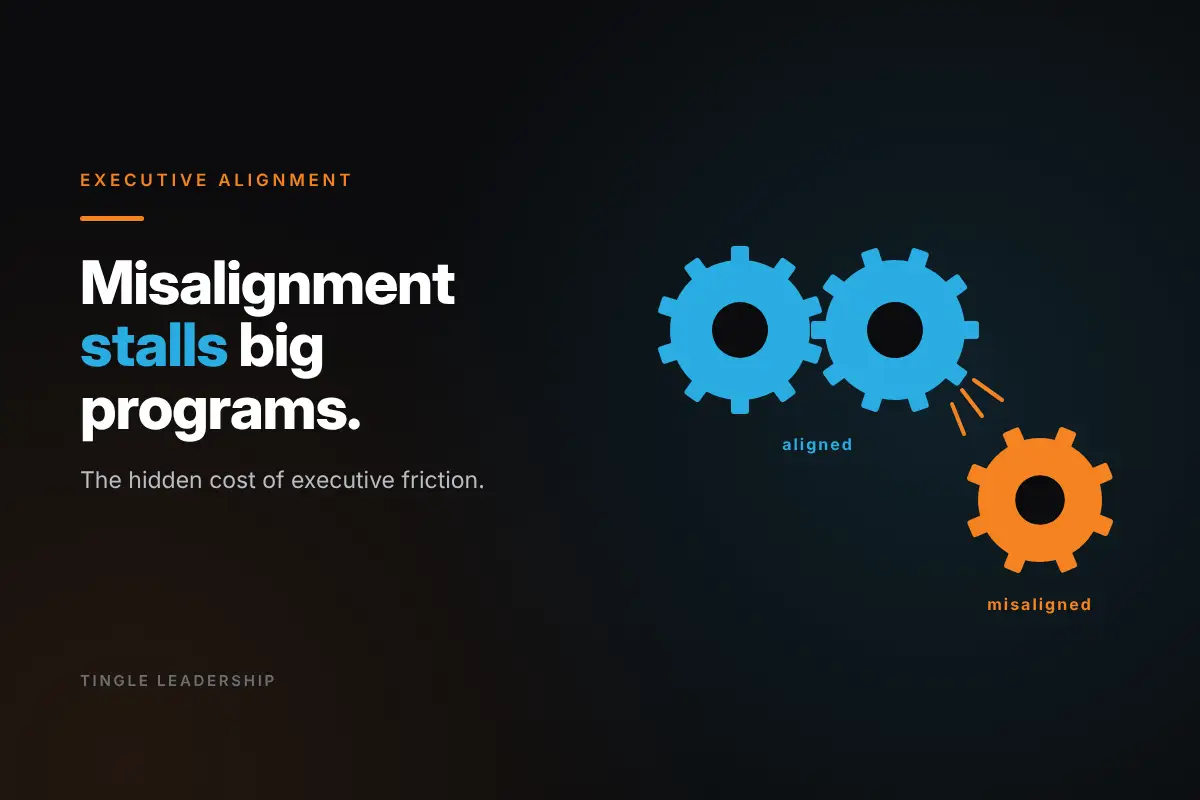
The biggest mistake in an executive meeting isn’t making a bad decision.
It’s when a lack of executive alignment is obvious to everyone.
In big companies, major projects are rarely cancelled completely. Instead, they get delayed, watered down, or quietly pushed aside. Usually, the real problem isn’t the strategy, it’s how executives act when under pressure.
When big, cross-team changes are happening, visible tension between executives can slow things down by several months. This isn’t because the plan is bad, but because people lose confidence in the leadership team.
Teammates spend valuable time talking about the conflict within the leadership team.
If someone says, “We tried this before. It failed,” the real issue isn’t the comment. The real risk is whether people still believe the executive team can work together.
If you get defensive, three things happen right away.
- The discussion moves from solving the problem to people protecting their own turf.
- Leaders start thinking about how much risk they’re taking on.
- The CEO starts worrying about whether the plan can actually be carried out, instead of focusing on the strategy itself.
At that point, decisions slow down. Money and resources sit unused, and it takes longer to see results. This directly hurts the return on investment.
How Executives Behave Sends a Governance Signal
Boards don’t mind disagreement. What worries them is instability.
When unhealthy tension between executives shows up in important meetings, it usually points to one of three governance problems:
- No one is sure who gets to make the final call.
- People have different comfort levels with risk.
- Support for the project might fall apart when things get tough.
Once these signals appear, there’s more oversight, less freedom, and tighter control over spending.
Staying calm isn’t just about looking good. It helps keep trust in leadership. How executives act under pressure affects the level of freedom the company grants them.
Most Emotional Moments Reveal Deeper Structural Problems
Heated exchanges in executive meetings are rarely personal. They are unresolved structural tensions surfacing in real time.
Different teams want different things.
There aren’t enough resources to go around.
The tradeoffs are unclear.
People have different timelines for how much risk they’re willing to take.
If we see these moments as personality clashes, we miss that they’re really about the system. Many delays in big changes are actually governance problems that just look like personal disagreements.
An executive’s job isn’t to hide tension. It’s to turn that tension into a clear direction without making things worse.
When a colleague says, “This won’t work,” I don’t hear it as criticism anymore. I hear one of four deeper concerns:
- We don’t have the capacity to execute this well.
- The value case isn’t convincing yet.
- The operational disruption feels too risky.
- There is doubt that sponsorship will hold under pressure.
If I focus on how something is said, we waste weeks. If I address the real issue, we get everyone back on the same page.
The Discipline That Keeps Things Moving
Staying composed as an executive is a skill, and it has three key parts.
First, manage your emotions openly and quickly. People in the room will follow the lead of the most senior person. If you lose your composure, everyone else will too.
Second, turn comments into questions about business risk. For example, ask:
“Is this a capacity constraint or a confidence issue?”
“What failure mode concerns you most?”
“What would need to be true for this to succeed?”
These questions shift the discussion from opinions to real risks and next steps.
Third, ensure trade-offs are clear and openly discussed.
Are we stopping?
Reducing scope?
Accepting risk?
Who owns mitigation?
Unstated tradeoffs resurface later as execution drag. Being clear about them up front creates accountability.
Why AI Programs Lose Momentum
Big AI and digital projects rarely slow down because the technology doesn’t work. They slow down because executives stop working together when things get tough.
When Operations slows data access due to visible tension, AI model accuracy becomes irrelevant.
When Finance delays staged funding because sponsorship appears unstable, momentum evaporates.
When the top team is not aligned, risk stories multiply, and every governance and approval process slows down.
What should have been a twelve-month value realization becomes an eighteen or twenty-four-month negotiation. That gap isn’t technical. It is behavioral.
Composure under pressure protects decision velocity.
The Standard to Aim For: Visible Executive Alignment
We usually promote executives because they are very good at their function.
We almost never test how well they handle tough, public pushback when big money is on the line.
But that skill often decides whether a transformation moves fast or grinds to a halt.
The costliest mistake in an executive meeting is not choosing the wrong direction. Most strategic errors are reversible.
Erosion of executive confidence is not. It compounds across every initiative.
Once doubt about cohesion enters the system, oversight increases, autonomy contracts, and speed declines.
In an environment defined by capital scrutiny, AI investment pressure, and margin compression, speed with alignment is not a cultural aspiration.
P.S. If executive friction is slowing critical initiatives in your organization, it is worth addressing directly.
I work with leadership teams to strengthen alignment under pressure and protect decision velocity in high-stakes environments.
If that would be useful, you can book time with me here.