With all the conversation around toxic work culture and bad leadership, I wanted to offer a perspective that can help. Let me start with a story.
A client of mine worked under a toxic executive. The impact was immediate. Meetings felt tense. Collaboration stalled. People watched every word they said. The poison was spreading fast.
As we discussed the situation, my client focused on what she could control. She committed to one thing that would protect her team and the broader culture: building and sustaining healthy relationships. It was the antidote to the executive’s viral behavior.
She knew the executive would eventually be removed. So, she strengthened her relationships and coached her direct reports to do the same. She met consistently with peers and maintained honest, steady connections with senior leaders. When she saw tension forming, she addressed it early. When communication broke down, she cleaned it up. When trust slipped, she brought people together for alignment.
When the executive was finally let go, the culture recovered quickly, not because of a reorganization or a program. It recovered because of the established relational foundation. Healthy relationships stabilized the environment while leadership issues played out.
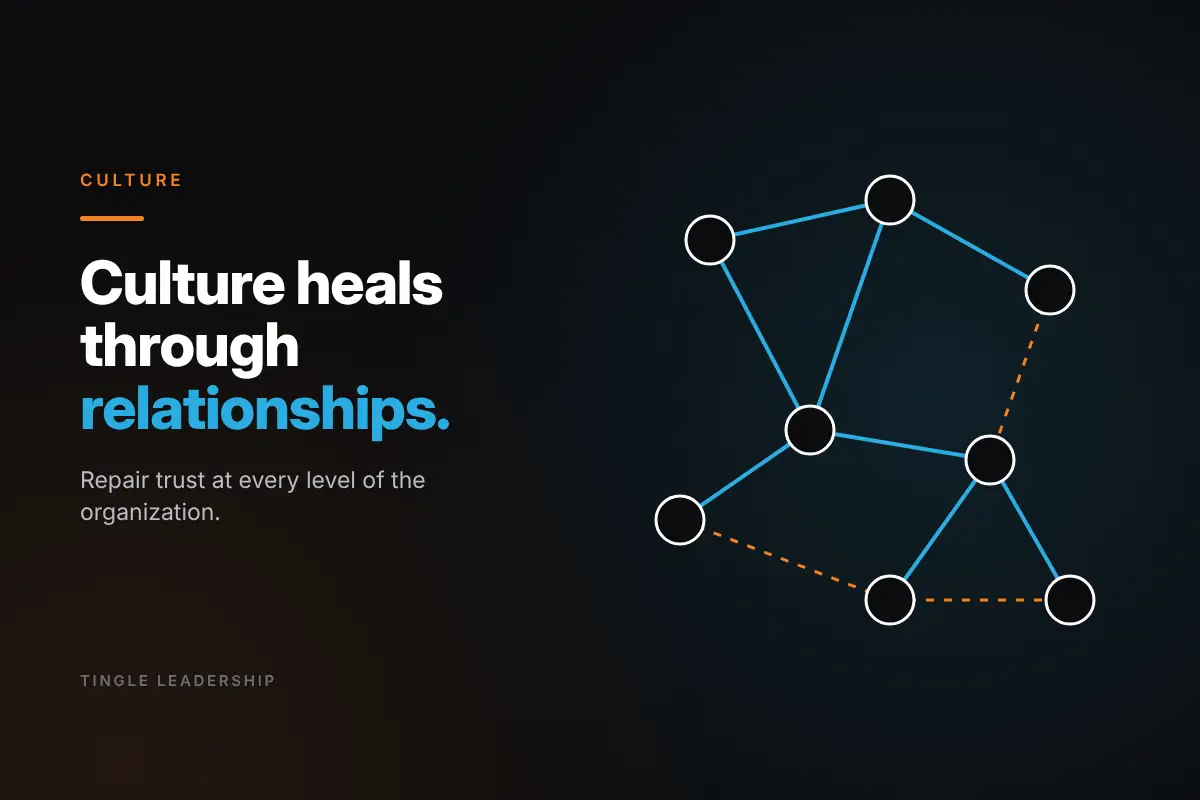
Healthy relationships are the core of cultural health. Everything else depends on them.
The Healthy Relationship Culture Framework
Culture doesn’t collapse because of structure. It collapses when relationships break down. The reverse is also true. Culture improves when relationships improve.
The Myth: A Toxic Work Culture Is About Systems
Most people believe toxic cultures come from workload, pay, or processes. So organizations respond with reorganizations, productivity tools, or policy changes.
But when employees describe a toxic culture, they almost always point to relational failures, especially those modeled by leaders.
Common signals include:
- Poor communication
- Fear of speaking up
- Lack of respect
- Exclusion
- Dishonesty
- Favoritism
- Bullying
- Sabotage
None are structural. All are relational.
A high-stress job can feel healthy when people support one another. And a well-resourced job can feel toxic when relationships deteriorate.
Why Relationships Matter Most
MIT Sloan found toxic culture is 10.4 times more predictive of turnover than compensation. Senior leaders leave toxic cultures even when they are paid more.
Healthy relationships create:
- Psychological safety
- Strong collaboration
- Resilience during stress
- Innovation and discretionary effort
When relationships erode, energy shifts to politics, impression management, turf battles, and blame.
Strong relationships are not a “nice to have.” They are the backbone of retention and performance.
Three Levels of Culture Repair
Fixing culture requires action at three levels. All three matter.
Level 1: Organizational Design
- Realign incentives to reward collaboration, not individual competition.
- Grade leaders on teamwork, mentorship, and cross-functional cooperation.
- Design structured cross-functional interactions.
- Train employees to address poor behavior.
Level 2: Leadership Behavior
- Use the 5 to 1 ratio. Five positive interactions for every one critical one.
- Share real positive assessments, not vague encouragement.
- Show vulnerability. Admit mistakes. Say “I got that wrong” or “I do not know.”
- Ask what you are missing before deciding. “How does this affect your workflow?” Inclusion builds trust.
Level 3: Individual Action
- Use the WAIT principle (“Why am I talking?”). Invite quieter voices.
- Show visible respect. Turn on your camera. Stay present. Put away your phone.
- Connect people. Share information. Introduce colleagues who should know each other.
The Real Work Starts With You
People often point to external conditions and blame the culture. Some leave. Others tolerate it quietly.
But your greatest power sits inside your immediate circle. You influence the environment through how you build and maintain relationships.
Start with small, visible actions.
- Notice and acknowledge someone’s contribution.
- Repair a strained relationship.
- Admit a mistake.
- Invite a quiet voice to speak.
- Ask a colleague how you can support them.
These actions shift the environment even when structures do not. They create safety, trust, and connection. And they build momentum for the culture you want.
Toxicity feels permanent, but it isn’t.
Healthy relationships are the cure.
________________________________________
If you want to strengthen relationships across your organization and improve cultural health, I invite you to book a call. We will discuss your environment, identify the relational gaps, and build a plan you can use immediately.