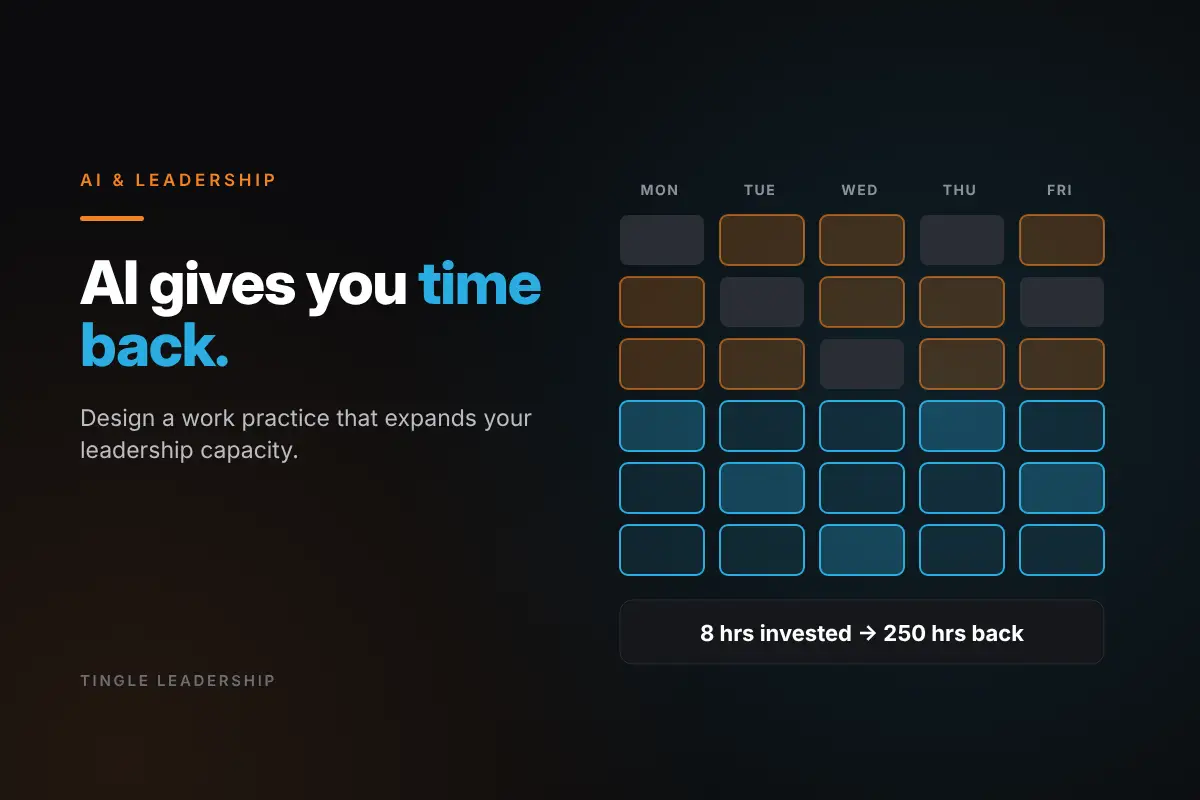
Leaders today face an impossible paradox. Expectations keep rising. Time doesn’t.
Here’s the truth most leadership advice misses: you can’t manage time. You can only manage capacity and commitments.
That’s the real promise behind AI leadership capacity. Used with intention, AI doesn’t just make you faster. It gives you back the bandwidth to lead.
Recent research backs this up. When leaders adopt AI tools intentionally, they increase capacity, reduce burnout, and free up space for strategic, high-impact work.
This issue breaks down how to build that practice.
Why AI Leadership Capacity Matters
- AI-enabled workplaces report a 25% drop in emotional exhaustion, a key burnout marker.
- AI automates busy work, freeing leaders for relationships and decisions.
- AI strengthens creativity, collaboration, and decision-making capacity.
AI isn’t just an efficiency booster. It’s a capacity multiplier.
The Framework: How AI Gives Back Time
AI gives leaders back time in three ways: prioritizing tasks, optimizing schedules, and streamlining collaboration.
Task Prioritization: AI ranks tasks by urgency and importance, so you stop starting your day by guessing.
Smart Scheduling: Virtual assistants find your optimal focus windows. Executives using these tools save up to 5.4% of weekly work hours.
Seamless Collaboration: AI project tools cut miscommunication and delays before they cost you a full afternoon of cleanup.
Try this: Review your weekly calendar. Pick 2 to 3 recurring tasks you could hand off to AI scheduling, transcription, or prioritization tools this week.
Addressing Burnout With AI
Burnout happens when capacity collapses. AI can spot the early warning signs and help you recover bandwidth before it does.
- AI monitors markers like long hours and disengagement, then recommends workload rebalancing.
- AI tools coach leaders through empathetic conversations about stress.
- AI-powered wellness nudges remind leaders to pause, recharge, and rebalance.
AI supports healthier work rhythms. But only when you pair it with empathy and real leadership presence. The tool spots the pattern. You still have to lead the conversation.
Research That Matters
The data on AI leadership capacity is consistent across multiple studies:
- Upwork Research Institute: Employees using AI saw a 40% productivity boost. 77% of executives confirmed real ROI.
- MIT/Stanford: Generative AI users cut weekly work hours by 5.4%.
- Harvard/MIT: Knowledge workers improved performance by nearly 40% when AI fit the task.
- McKinsey 2025: Leaders using AI strategically secured 20 to 40% efficiency improvements.
- BCG Global Survey: 53% of leaders facing higher productivity demands now use AI to meet them.
Bottom line: AI works when it’s embedded intentionally into how you lead, not bolted on as an afterthought.
AI Workflows That Cut Meeting Time
Meetings drain leaders. AI tools are rewriting the playbook.
- Smart Scheduling: Motion and Reclaim AI eliminate the back-and-forth by automatically finding optimal times.
- Agenda Generation: Tools like Fellow pull data to build focused agendas before the meeting starts.
- Real-Time Summaries: Otter.ai and Fireflies transcribe, summarize, and assign action items automatically.
- Post-Meeting Analytics: AI assistants track follow-ups, so decisions actually stick.
Executives using these tools save up to 30% of meeting time while improving clarity.
Top 10 AI Tools for Leaders
- Motion — automated scheduling and task defense
- Reclaim AI — calendar optimization and protected breaks
- Otter.ai / Fireflies — meeting transcription and follow-ups
- Notion AI — document and task generation
- ChatGPT / Claude / Gemini — executive assistant functions
- SaneBox / Superhuman AI — smarter email management
- Avoma / Fathom — real-time meeting intelligence
- Slack AI / Copilot — smarter team communication
- Asana AI / ClickUp Brain — automated project management
- Headspace Ebb / VantageFit — personalized wellness nudges
Try this: Pick one tool from this list and trial it for 14 days. Track how much time it actually gives back.
Note for corporate users: We know most companies have standards and policies for software adoption. Work with your IT team to adopt, adapt, and align any of these tools to your organization’s requirements.
Is the Learning Curve Worth It?
Yes. Here’s the data:
- Netguru 2025: Executives save 5 to 7 hours weekly after a one-time 3 to 20 hour learning curve.
- Atlassian 2025: Developers saved 10+ hours weekly after just 5 to 8 hours of training.
- St. Louis Fed 2025: Early adopters saved 1 to 3 hours weekly. Digital-native teams saved even more.
Return on Time example: 8 hours invested → 250 hours saved in a year. That’s a 30x Return on Time.
AI Isn’t About Working Faster
AI isn’t about working faster. It’s about creating capacity for what matters most.
Leaders who integrate AI intentionally don’t just do more. They reclaim energy, focus, and resilience.
Your coach, Bill
P.S. Want a complimentary brand strategy call? Book time with me here.