Let me tell you about the promotion that looked like a win on paper but quietly capped my impact, and what it took to become a strategic partner instead.
For years, my career was built on saying yes.
I took the late-night calls.
I jumped into projects that were already off the rails.
I agreed to timelines that made no sense but “had already been promised.”
On the surface, it worked.
I became the go‑to person when things were on fire.
Senior leaders praised my reliability and grit.
I was trusted with the hardest problems in the system.
But there was a hidden cost.
I was almost never in the room when the risky commitments were made.
I inherited decisions I hadn’t shaped, then carried the blame when reality caught up.
My team lived in churn while other leaders got invited into the strategy conversations.
The turning point was a steering committee where, once again, I was asked, “Can you hit this date?”
I heard myself say, “We’ll do our best,” even though I knew the scope and risk were wrong.
Walking out of that room, it hit me: my habit of “just make it happen” wasn’t loyalty anymore. It was complicity.
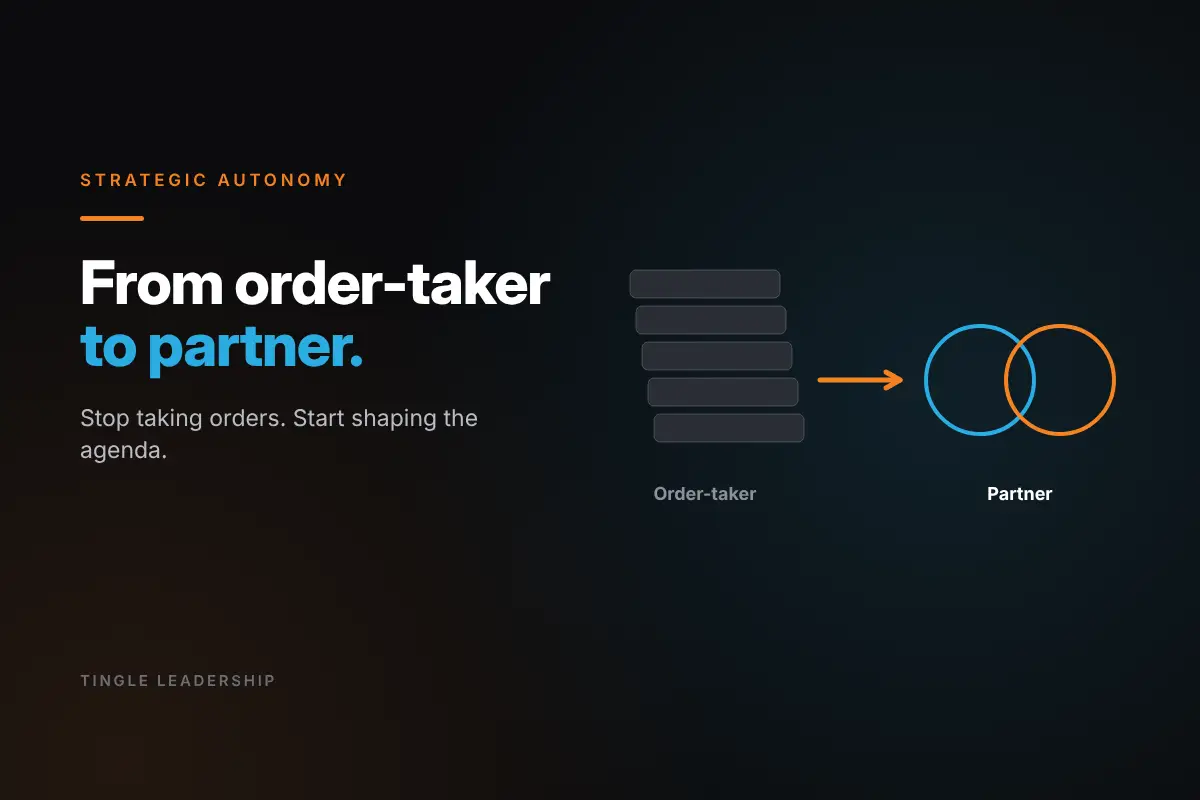
From Order-Taker to Strategic Partner
Here’s what I know now that I didn’t know then:
Executives don’t only need people who can ship.
They need people who can shape.
Strategic Autonomy is the name I use for that shift.
It’s the move from “Tell me what you need, and I’ll deliver.”
to “Let’s decide together what we’re solving for, and what we’re not willing to do.”
The old belief was:
“If I take on the hardest work and always deliver, I’ll get more influence.”
The new belief is:
“If I don’t shape the work before it hits my team, I’m not leading. I’m just cleaning up.”
Three Moves That Shape the Work
So what does the simpler, better model look like in practice? Three moves.
Frame the problem, don’t just accept it.
Before diving into “Can we build this by Q2?”, step back.
Ask: “What business outcome are we aiming for?”
“What would success look like even if we didn’t ship this exact thing?”
That one “zoom‑out” question often changes the entire conversation.
Offer options and a recommendation.
Instead of “We’ll do our best,” try:
“I see three options. Here’s what each costs, what each gives us, and what I recommend.”
Suddenly, you’re not the implementation arm. You’re shaping the decision landscape.
Name the trade‑offs out loud.
“If we say yes to this as scoped and timed, here’s what we’re saying no to, and here’s the risk we’re accepting.”
You’re not being difficult. You’re making the real decision visible so the organization can make a conscious choice.
These are small shifts, but they add up.
You go from being the firefighter everyone calls when things break,
to the enterprise partner who prevents self‑inflicted fires in the first place.
❝ I stopped saying ‘We’ll do our best’ and started saying ‘Here are the options I recommend.’ Within a quarter, I was pulled into roadmap discussions instead of just handoffs. ❞ – Tony, VP Application Development
This is exactly what I built: Executive Freedom: A 12‑Week Challenge for Tech Leaders.
The challenge is for the VP, Director, or rising leader who’s technically strong but tired of being treated as the implementation arm.
Instead of vague “executive presence” advice, you get concrete experiments you can run in the meetings you already have.
Here’s what you get inside the 12‑week challenge:
- A clear 12‑week win: the specific way you want your role to look different by the end.
- A deep dive into three pillars:
- Strategic Autonomy – shaping what you work on, not just how.
- Visible Authority – how you speak and decide so others can follow.
- Trusted Belonging – being seen (and seeing yourself) as a peer at the executive table.
- Simple, repeatable practices you can use in:
- Leadership team meetings
- 1:1s with your manager or CEO
- AI / transformation steering committees
- A structure for turning “one good meeting” into a new default, so people start talking about you differently when you’re not in the room.
If you’re tired of inheriting unrealistic commitments and being the one who “makes it work” at any cost, and you want to become the leader who calmly shapes which bets your organization makes in the first place, start with Strategic Autonomy.
If you’re done being the high‑status order‑taker and you want to become the enterprise partner your CEO actually leans on, you can learn about the 12‑week challenge by booking some time with me to discuss.
P.S. The work in Executive Freedom is built for experienced tech leaders who already know how to deliver. If you’re still learning the basics of your leadership role and would like to learn about our 1:1 coaching or group leadership development cohort, book some time with me here.
P.P.S I’ve captured the entire Executive Freedom Framework in a short paper you can read in under 10 minutes.
If you’d like a copy, simply email:
“Bill, send me the Executive Freedom paper.”
Send it to:
I’ll send it directly to you.