|
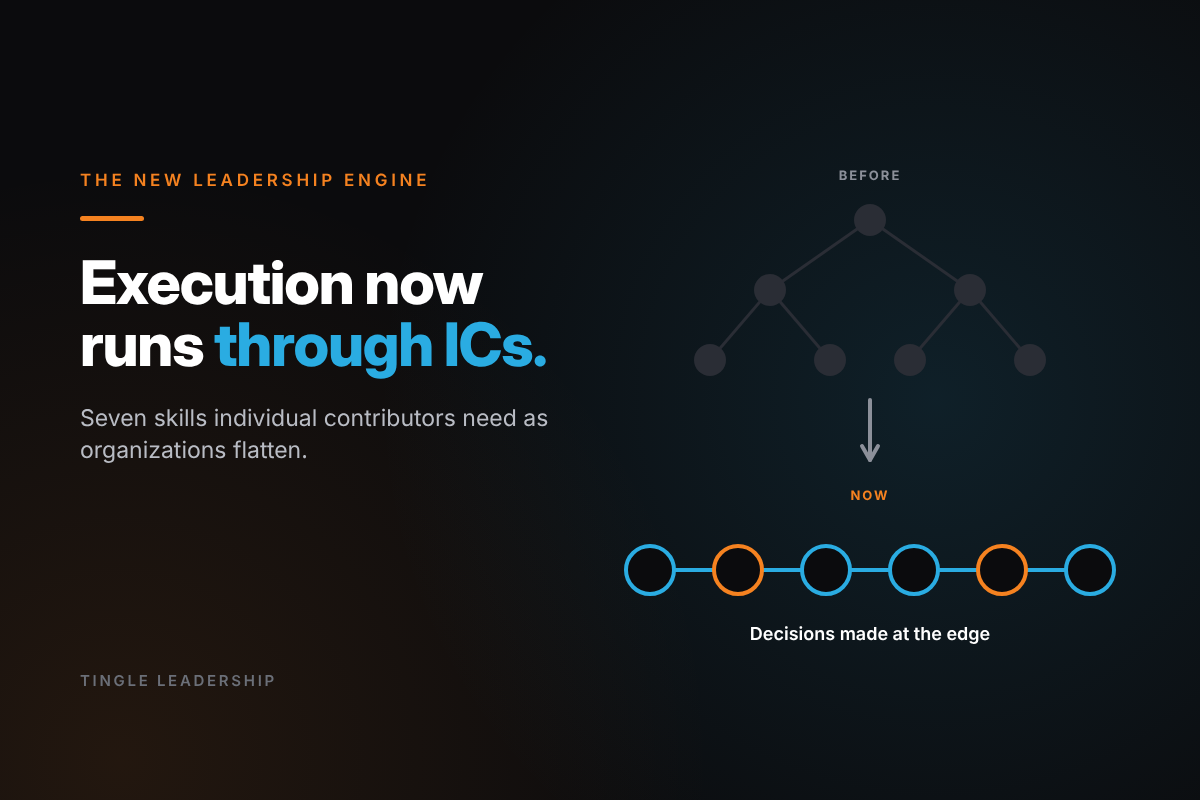
Individual contributors (ICs) are no longer specialists who execute instructions. As organizations flatten, accelerated by AI and the collapse of middle management, ICs now sit at the intersection of strategy, technology, and customer reality, making decisions and shaping outcomes in real time. The question for senior leaders is not whether to invest in individual contributor leadership. It is how fast you can do it, and what it will cost if you do not. The great flattening is already underwayOrganizations are removing management layers in response to cost pressure, AI automation, and demands for faster decisions. Roles that relay information up and down hierarchies are shrinking, especially in corporate middle management. On paper, this looks like efficiency. Fewer layers. Leaner teams. Shorter paths. In practice, flattening creates serious execution risk unless ICs are ready to lead. Work still requires coordination. Tradeoffs still need judgment. Conflict still needs resolution. In flatter structures, that responsibility shifts to ICs. When they are not equipped, predictable failure patterns emerge:
Developing leadership capacity in ICs transforms flattening from a liability into a performance advantage. Beyond Technical Excellence: Individual Contributor LeadershipOrganizations have historically developed ICs for technical depth. That model worked when managers absorbed coordination and leadership work. In flatter organizations, technical excellence remains essential but insufficient. The work managers handled does not disappear; it shifts to ICs. Influencing peers. Aligning across teams. Translating strategy into action. Coaching others. Organizations that outperform redefine the IC role from expert doer to expert leader. Seven skills matter most:1. Strategic thinking and business acumenICs now make more decisions without direction. This requires understanding customers, economics, and priorities. Strong ICs:
This reduces escalation noise and improves decision quality. 2. Influence without authorityIn flat structures, progress flows through networks, not reporting lines. High performers:
This limits silos and keeps cross-functional work moving. 3. Advanced communicationWithout managers to translate, ICs must communicate directly with executives, customers, and peers. This means:
This shortens decision cycles and eliminates unnecessary meetings. 4. Collaboration and networked executionWithout formal coordination layers, alignment must be created laterally. Strong collaborators:
This lowers execution risk and enables complex initiatives without rebuilding hierarchy. 5. Ownership, autonomy, and execution disciplineFlattened models assume autonomy. Autonomy without ownership produces chaos. Execution discipline includes:
This enables distributed decision-making without sacrificing predictability. 6. Learning agility and adaptabilityAI and automation redefine roles faster than job descriptions can keep up. High-value ICs:
At scale, this reduces transformation risk and accelerates change. 7. Coaching mindset and informal leadershipAs management layers thin, leadership spreads horizontally. A coaching mindset shows up when ICs:
This preserves culture and capability even as structures evolve. How to reposition IC development with your executive teamIC development must be positioned as core operating infrastructure, not a benefit program. Effective framing includes:
This is not about turning every IC into a manager. It is about ensuring leadership exists wherever work happens. Final thoughtThe organizations that outperform during the great flattening will treat individual contributors as the primary engine of leadership, not simply execution. Senior leaders who deliberately build these capabilities will not only absorb structural disruption, but they will convert it into a lasting competitive advantage.
|
Transforming Tactical ICs to Strategic LeadersIn our Human Edge program, we are training individual contributors to become powerful leaders who coordinate with agility in today’s dynamic environment. If you’d like to learn more, Book a Call |